
Articles
Edible Dosing Chart: THC Milligrams by Experience Level
Nov
The safest starting point for an edible in Canada is 2.5 mg of THC or less, and the chart below shows how to step up from there. The 10 mg printed on many packages is a legal ceiling for the whole package, not a recommended dose. If you buy edibles from us, the mg per piece is on the product page, so you can match it to your row on the chart before you order.
TL;DR
- Start with 2.5 mg of THC or less, then wait at least 2 hours before considering more. Effects can take up to 4 hours to peak.
- Read the label carefully: “per unit” and “per package” mean different things, and the total can be several times the number you first notice.
- A typical intoxicating dose is 10 to 30 mg of THC, which is already a lot for someone who is new or who rarely uses cannabis.
- Effects can last up to 12 hours, with residual effects for up to 24 hours. Plan the day around that.
- If a dose feels like too much, stay somewhere safe, do not drive, and call poison control or 911 for serious symptoms.
Table of Contents
- Edible dosing chart: THC per serving
- Reading the THC number on the label
- How strong is 10 mg, 20 mg, 25 mg or 40 mg?
- Why edibles feel different from smoking
- Timing: when it starts, when it peaks, when to take more
- A step-up routine that works
- If you have taken too much
- What else the label rules tell you
- Shopping with the chart in hand
- Our view on dosing
- FAQ
- Sources
Edible dosing chart: THC per serving
This chart works in milligrams of THC per serving, which is the number that matters. It is a guide, not a prescription. Body weight, metabolism and tolerance all shift how a given amount feels.
| THC per serving | Who it suits | What to know |
|---|---|---|
| 1 to 2.5 mg | First-timers, people returning after a long break, adults over 55 | Government of British Columbia, Nova Scotia and Health Canada all point to 2.5 mg or less as the place to start |
| 2.5 to 5 mg | People who have tried 2.5 mg, waited out the full effect and want a little more | Step up on a later occasion rather than during the same session |
| 5 to 10 mg | Occasional users who already know how they respond | 10 mg is the federal maximum for a whole package, so it is a ceiling, not a target |
| 10 to 30 mg | Experienced, regular users | The range the Canadian Medical Association Journal calls a typical intoxicating dose |
| 30 mg and above | Not a starting range for anyone | The chance of over-intoxication rises, especially if tolerance is low |
The low end is the same across provinces. Nova Scotia says a low dose of edible cannabis is 2.5 mg THC or less. Health Canada recommends 2.5 mg THC or less per unit for adults over 55. The Northwest Territories gives the same 2.5 mg figure for a first try.
How to use the chart
Find the row that matches how you actually use cannabis, not how you would like to. Daily smokers sometimes assume their tolerance carries over to edibles. It does not carry over cleanly, because eating THC works differently from inhaling it (more on that below). If you are unsure between two rows, take the lower one.
Reading the THC number on the label
Most dosing mistakes happen before the first bite, at the label. Canadian labels must show total THC and total CBD, and Health Canada explains how to read the “per unit” and “per package” wording:
- “Total THC per unit 2.5 mg” on a package of four pieces means 10 mg in the whole package.
- “Total THC 10 mg” means the entire package contains 10 mg.
The federal rule behind this is simple. Under the Cannabis Regulations, edible cannabis may not contain more than 10 mg of THC per immediate container. Health Canada’s guidance adds that a container can hold several units, for example two units of 5 mg each, as long as each unit has the same amount and the total stays at or below 10 mg.
A worked example
Say you pick up a pack of four gummies labelled 2.5 mg of total THC per unit. One gummy is your starting dose. The whole pack is 10 mg. If you eat two gummies, you are at 5 mg, which is a step up, not a starting point. If you eat the whole pack because it “feels like one serving”, you are at 10 mg, four times the starting dose recommended by the provinces.
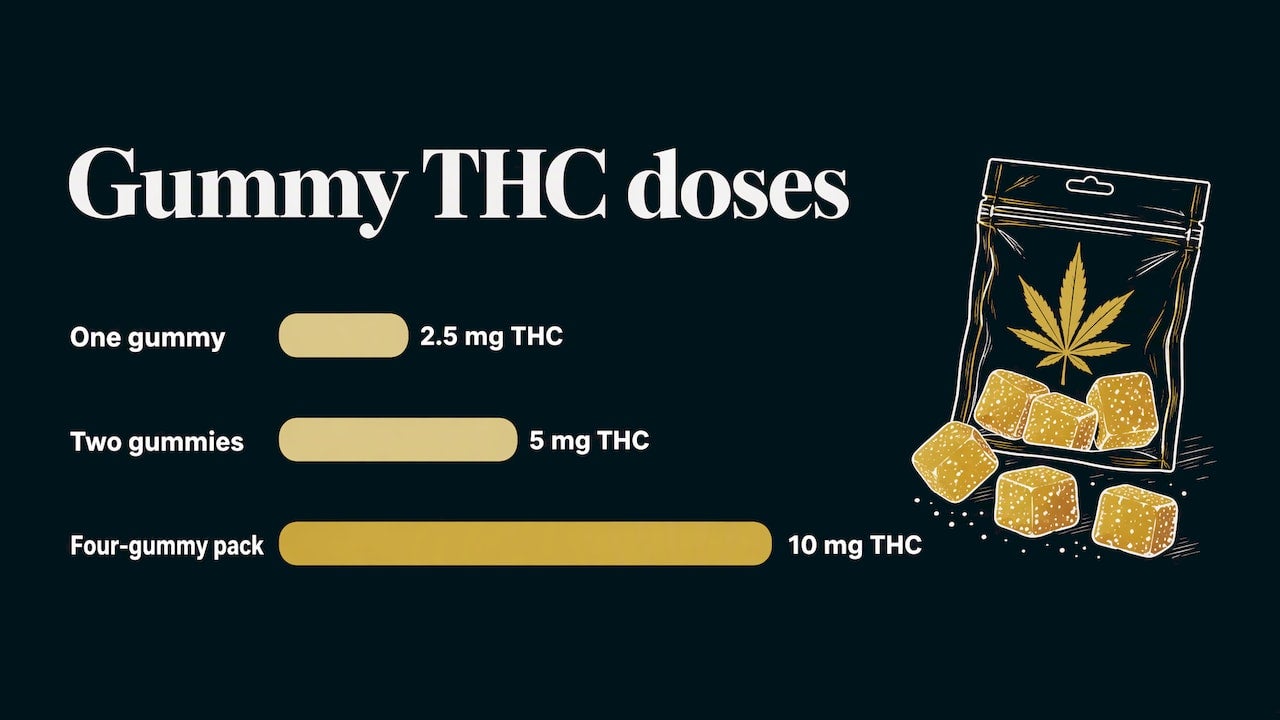
Nova Scotia states it plainly: 10 mg is not a dose, and you should start with 2.5 mg or less before consuming more.
A second check: look at the front of the package. Since 2025, every cannabis product must carry a health warning message in a yellow box. Health Canada updated its list of messages, which took effect on March 12, 2025. For edibles, that includes a warning that it can take up to 4 hours to feel effects, and that eating more before you feel an effect can cause cannabis poisoning.
Dividing a bigger piece
Cutting a large chocolate bar or cookie into smaller pieces is unreliable. THC is not always spread evenly through the product, and the CMAJ notes that difficulty dividing edibles is one cause of unintentional overdose. The easiest fix is to choose products already sold in small, individually marked pieces, so that one piece is one known dose.
How strong is 10 mg, 20 mg, 25 mg or 40 mg?
These are the questions readers type most, so here are direct answers.
- 10 mg: the legal maximum for one package. For a beginner, it is four times the suggested starting dose. For a regular user it is a moderate amount.
- 20 mg: twice the package limit and inside the 10 to 30 mg range that the CMAJ describes as typical for an intoxicating dose. Not a starting dose.
- 25 mg: also inside that range, and strong for anyone without a tolerance built up over time.
- 40 mg: above that typical range. It can lead to anxiety, a racing heart and disorientation in people who are not used to it. The Government of Quebec notes that too much THC can cause intense, uncomfortable effects such as rapid heartbeat, anxiety and disorientation.
The question “is 10 mg of CBD a lot?” is a different one. CBD is not intoxicating, and the numbers on a CBD gummy are not read on the THC scale. The 2.5 mg guidance is for THC.
Why edibles feel different from smoking
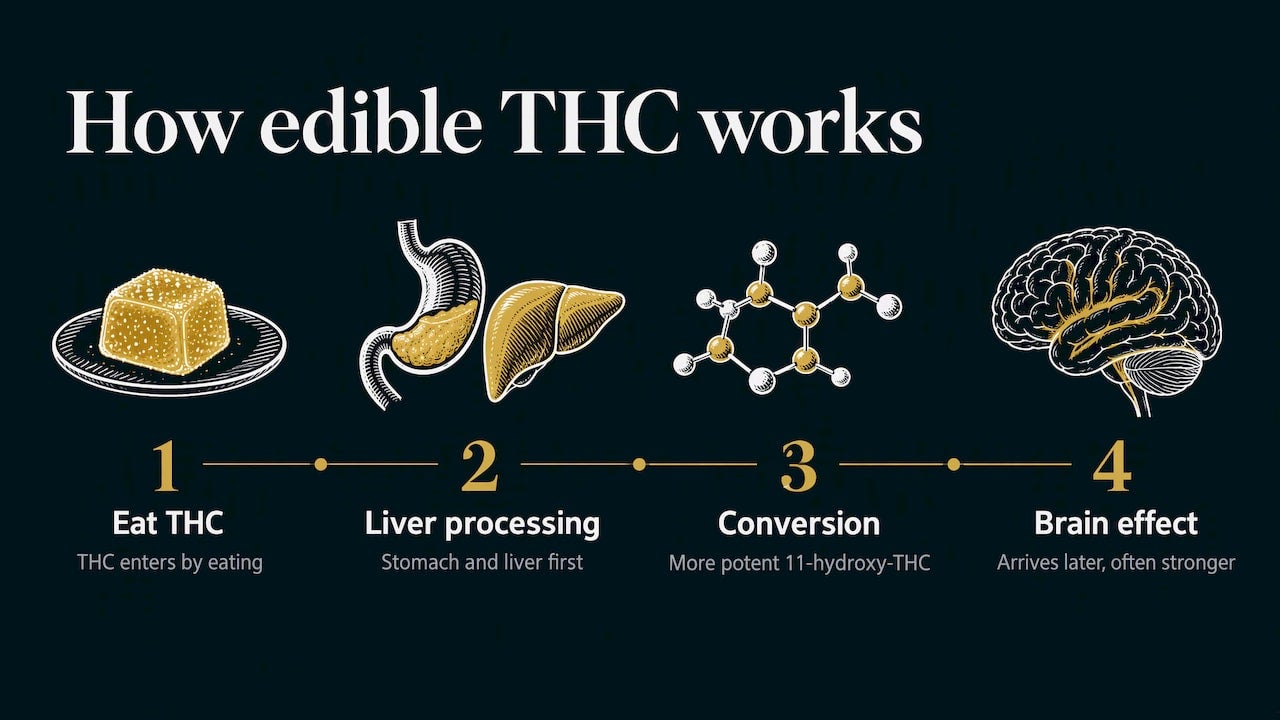
When you inhale cannabis, THC reaches your brain within minutes. When you eat it, THC goes through your stomach and liver first. Nova Scotia explains that the liver converts it into 11-hydroxy-THC, a more potent compound, before it reaches the brain. That is why the effect arrives later and often feels stronger.
The Canadian Centre on Substance Use and Addiction adds that for some people, edible effects can be more intense than a similar dose inhaled, because both the original THC and the liver-produced form shape the high.
This is the reason a daily smoker should not read the chart one row higher than a new user would. Smoking tolerance and edible tolerance are not the same thing.
Timing: when it starts, when it peaks, when to take more
Edibles are slow, and that is where most overconsumption starts: someone feels nothing at 45 minutes and eats more.
| Stage | What the sources say |
|---|---|
| Onset | 30 minutes to 2 hours (Nova Scotia, CCSA) |
| Peak | Around 4 hours (CCSA) |
| Duration | Up to 12 hours, with residual effects up to 24 hours (Government of British Columbia) |
How long to wait before a second dose differs a little between provinces. Nova Scotia advises waiting at least 2 hours. Manitoba recommends waiting at least four hours before a second serving. If you want the cautious answer, wait the full four hours, because that is when the effect peaks.
British Columbia notes that how soon and how long effects last depends on weight, metabolism, sex and whether you ate on an empty stomach. Two people eating the same gummy can have different evenings.
A step-up routine that works
- Pick a quiet time. Choose an evening or weekend with nowhere to be, and no driving. Effects can reach into the next day.
- Take 2.5 mg or less. One small piece from a clearly labelled pack.
- Wait. At least 2 hours, ideally up to 4, before you decide anything.
- Note how it felt. Too strong, about right, barely there. Write down the product and the amount.
- Adjust next time, not the same night. If 2.5 mg was comfortable but mild, try 5 mg on another day. Move up in small steps.
- Keep the same product while you learn. Different brands and formats can feel different, so changing both dose and product muddies what you learn.
British Columbia also warns that regular use of high-strength cannabis (more than once a week) can lead to tolerance and dependence, and advises against mixing cannabis with alcohol or other substances. Keep the dose steady rather than chasing a stronger effect each time.
For therapeutic use
If you are using edibles for a symptom such as pain or sleep, the same low-and-slow approach applies, and a steady, known amount makes it easier to see what is working for you. Talk with your doctor or pharmacist if you take other medication, since THC can interact with it. Our guide to choosing, dosing and using edibles for pain walks through that in more detail.
If you have taken too much
Too much THC is unpleasant and frightening, but you can get through it. Manitoba notes that you cannot die directly from taking cannabis, though you can become physically ill, extremely anxious or paranoid, and these effects can take several hours to pass. It adds that the risk is highest with homemade edibles, where the dose can’t be measured accurately.
What to do:
- Get somewhere safe and stay put. Do not drive or ride a bicycle. Manitoba advises this if effects are overwhelming but you have no chest pain, seizure or loss of contact with reality.
- For lesser symptoms, call your poison control centre for 24-hour advice. In Manitoba, poison control is 1-855-776-4766, and in British Columbia the BC Poison Control Centre is 1 800-567-8911 or 604 682-5050 (BC fact sheet).
- Call 911 or go to the emergency department for serious symptoms. Health Canada lists chest pain, rapid heartbeat, vomiting, psychotic episode, slowed breathing, severe confusion and loss of consciousness among the signs of consuming high quantities of THC.
Keep edibles out of reach of children and pets. Health Canada’s warning for edible packaging says edibles can poison children, with severe cases involving hospitalization for breathing difficulties, seizures or coma, especially in children under 5. Store them in their original child-resistant packaging, somewhere locked or high up.
What else the label rules tell you
Federal rules also shape what is inside a legal edible. Per Nova Scotia’s summary of the federal regulations, edibles may contain only food or food additives, can use only naturally occurring caffeine (from chocolate or tea, for example), must be shelf stable, must come in child-resistant packaging, and must carry health warnings. A label that follows this layout, with a clear per-unit THC figure and a warning box, is one you can read with the chart above.
Shopping with the chart in hand
We stock edibles across several formats, including gummies, chocolate, tinctures and beverages, and each product page carries detailed information and customer reviews. When you browse our cannabis edibles, look for the THC per piece first, then the number of pieces per pack, and do the multiplication before adding to your cart. If you are not sure which product fits your row on the chart, our live chat team can help you read a product page, and our help center covers the common questions. We ship across Canada to adults.

If you are choosing something for a specific purpose, the guide on how Canada’s THC limits apply to a popular edible is a good next read.
Our view on dosing
We think a dosing chart is only as good as the habits around it. The chart gives you a number, but the routine gives you a good evening: a quiet setting, one small piece, patience, and a note of what happened.
Our customers range from long-time enthusiasts to people buying their first edible, and we build the shop for both. That is why we put the details on each product page and offer live chat and a help center: the mg per piece, the pack format, and reviews from other buyers should be easy to find before you check out.
Our advice to a new user is the same as the provincial guidance: start at 2.5 mg or less, give it the full time, and move up only on another day. For experienced users, the same discipline keeps a favourite product enjoyable instead of overwhelming. If you want help matching a product to your row on the chart, ask us in chat.
the author
FAQ
Is 25 mg a lot for an edible?
Yes, for most people it is. It sits inside the 10 to 30 mg range the CMAJ calls a typical intoxicating dose, and it is ten times the 2.5 mg starting amount that provinces recommend for beginners. Regular users with a high tolerance may find it manageable, but it is not a starting point.
How strong is a 20 mg gummy?
A 20 mg gummy is twice the federal limit for a whole package of edibles, so check how it is sold and read the label. Its strength is within the typical intoxicating range of 10 to 30 mg. If you are new, a piece that size is far above the 2.5 mg starting dose, so choose a lower-mg product.
Is eating 40 mg of edibles a lot?
Yes. It is above the typical 10 to 30 mg intoxicating range and can bring anxiety, a racing heart and disorientation, particularly if your tolerance is low. Effects can last up to 12 hours. If you have taken too much, stay somewhere safe, do not drive, and contact poison control or 911 for serious symptoms.
How long should I wait before taking more?
At least 2 hours according to Nova Scotia, and four hours according to Manitoba. Effects peak around 4 hours, so the longer wait is the safer one. If you still want more after that, increase on another day instead.
Does the 10 mg on the package mean one dose?
No. Ten milligrams is the legal maximum THC for the whole package, and the label may split it across several pieces. A pack of four with 2.5 mg per piece contains 10 mg in total, so one piece is the starting dose, per Health Canada’s label guide.
Sources
- How to read and understand a cannabis product label, Health Canada
- Cannabis Regulations (SOR/2018-144), Justice Laws Website
- Guide on composition requirements for cannabis products, Health Canada
- Cannabis health warning messages, Health Canada
- Health effects of cannabis on adults over 55, Health Canada
- Extracts and Topicals Cannabis, Government of Nova Scotia
- Cannabis Label Pamphlet, Government of the Northwest Territories
- Lower-risk cannabis use, Gouvernement du Québec
- Good and Bad Experiences, Province of Manitoba
- Cannabis Myths, Province of Manitoba
- Edible cannabis, CMAJ
- 7 Things You Need to Know about Edible Cannabis, CCSA
- Cannabis edibles incorrectly sold as cannabis extracts, Health Canada recall alert
Recommended
- Edibles for Pain: How to Choose, Dose and Use Them Well
- Sky High Edibles – THC Gummies (600mg)
- Medicated Edibles – Hard Candies (120mg)
- Medicated Edibles – Cake Pops (100mg)
