Articles
Cannabis Strains for Anxiety: How to Choose Calmer Products
Nov
The best cannabis strains for anxiety are not defined by a name like “Girl Scout Cookies” or “Harlequin”. They are defined by chemistry: a CBD-dominant or balanced CBD and THC profile, a low THC dose and a format you can measure. Canadian research shows that THC can calm anxiety at low doses and provoke it at high ones, so the label on the product matters more than the strain’s reputation. Here is how to read it, where to start and how to shop with confidence.
TL;DR
- Look for CBD-dominant or balanced CBD:THC flower, edibles or vapes. High-THC products are the most likely to bring on racing thoughts or paranoia.
- Strain names are marketing shorthand. THC and CBD percentages (or mg per serving) and the terpene information tell you far more.
- New consumers are advised by Health Canada to start with an ingested product of 2.5 mg THC or less and to wait up to 4 hours before taking more.
- Evidence for cannabis as an anxiety treatment is limited. If your anxiety is severe or ongoing, talk to a doctor or nurse practitioner before you use it.
- On our site, product pages carry detailed information and customer reviews, and live chat is there when you want a second opinion on a label.
Table of Contents
- What “good for anxiety” actually means
- Why THC dose decides whether a strain calms or rattles
- Four product profiles to know
- What the research says about specific chemistry
- How to read a product page like a pro
- Starting low: the rules for new and returning users
- Why cannabis can make anxiety worse
- Shop calmer, with support
- When to talk to a professional
- FAQ
- Sources
What “good for anxiety” actually means
Most lists of anxiety strains rank cultivars by name and mood. The problem is that the same name can mean very different chemistry from one grower to the next. Health Canada says plainly that there is not enough scientific information for it to recommend which cannabis product to take for any specific condition, so people choosing a product rely on trial and error guided by the label: CBD and THC percentages, the format, and the amount of cannabinoid per dose.
That gives you a practical definition. A product suited to a cautious, anxiety-prone shopper usually has:
- A lower THC level, or a CBD-dominant ratio.
- A clear lab-style breakdown of cannabinoids, and ideally terpenes.
- A format you can dose precisely, such as a gummy with a stated milligram amount.
A quick note on terms. THC is the cannabinoid that causes the high. CBD does not cause a high. Health Canada’s overview says the plant contains more than 100 cannabinoids, and that THC and CBD act on body systems involved in stress and emotional state. Terpenes are the aromatic compounds that give a strain its smell, such as citrus or pine. If you want the basics first, our guide to what CBD and THC are, with benefits and risks covers them.
Why THC dose decides whether a strain calms or rattles
This is the single most useful fact for anyone shopping for anxiety relief. The CCSA (Canadian Centre on Substance Use and Addiction) 2024 update on medical cannabis notes that human studies show a dose-dependent effect of THC on anxiety: low doses can reduce anxiety, and high doses can produce it. The same report describes the evidence for cannabinoids in treating anxiety as limited and controversial, and says about 90% of people who use cannabis for anxiety or depression report that it is effective.
What does that mean at the counter? A strain that feels wonderful at a small amount can feel awful at a large one. Many first-time bad experiences come from taking too much of a strong product, not from the “wrong” strain.
A 2022 review of recent findings found that THC’s anxiety-provoking effects may be blunted in regular users and when THC is taken together with CBD. Another review concluded that products containing primarily CBD may be more suitable for people with pre-existing anxiety. Together these explain why CBD-dominant and balanced products top most sensible shortlists.
Health Canada treats products above 10% or 10 mg THC as high, and its mental health page notes that daily or near-daily use over time increases the chance of developing anxiety and depression disorders. It also advises people with a personal or family history of mental health disorders to take extra care. If that describes you, speak to your doctor or nurse practitioner before buying.
Four product profiles to know
Instead of memorizing strain names, learn these profiles. They are how a careful shopper sorts a menu.
| Profile | What to look for on the label | Why people consider it for anxiety |
|---|---|---|
| CBD-dominant | High CBD, THC near zero or very low | Little or no intoxication, so nothing to trigger a racing mind |
| Balanced 1:1 | Similar amounts of CBD and THC | CBD may soften THC’s edge, as the 2022 review suggests |
| Low-THC hybrid | THC in the lower range, some CBD | Gentle effect for people who want a light lift |
| High-THC | THC well above 10% | Highest chance of paranoia or panic, so it is the profile to approach last, if at all |
People often ask whether indica or sativa matters. Those labels describe plant shape and marketing tradition more than reliable effects. Check the cannabinoid numbers first, then the terpenes, and treat the indica or sativa tag as a loose hint.
What the research says about specific chemistry
Two Canadian studies are worth knowing because they look at real-world use.
A 2023 Canadian study in the Journal of Cannabis Research followed 184 people using dried flower and found a significant anxiety reduction of about 50% on average across three cultivars. The same study found the best dose differed by sex (9 to 11 inhalations for males and 5 to 7 for females in its results) and that the effect was weaker in people aged 40 and over. The takeaway is not a number to copy. It is that dose and the individual matter.
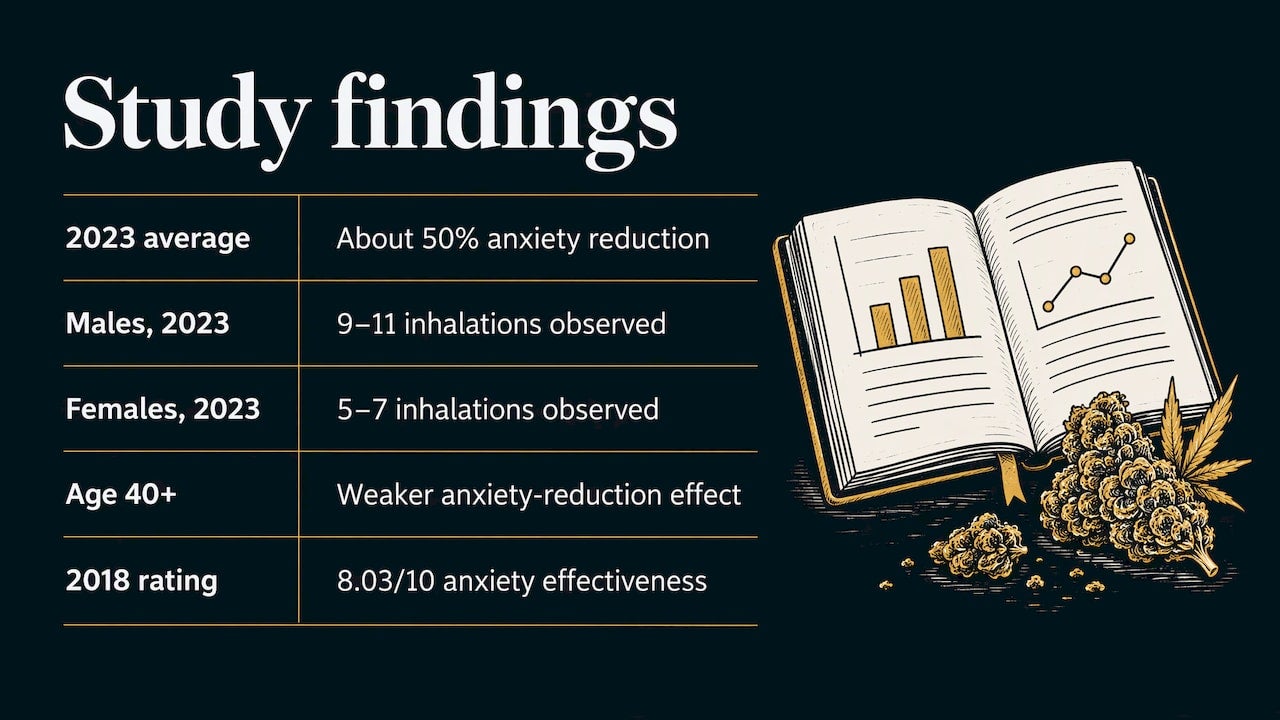
A 2018 chemotype study in Frontiers in Neuroscience found patients rated cannabis 8.03 out of 10 for anxiety effectiveness. In that data, THC and the terpene trans-nerolidol correlated with stronger anxiolytic (anxiety-reducing) activity, while guaiol, eucalyptol, γ-terpinene, α-phellandrene, 3-carene and sabinene hydrate correlated with weaker activity. This is early, correlation-level evidence. It does suggest that two products with the same THC percentage can feel different because of their terpene mix, which is why detailed product information is worth reading.
Health Canada’s expert committee on CBD, in its 2022 report, found some early evidence that CBD may help with short-term (under 30 days) mild symptoms of stress and nervousness, and found oral CBD at 20 to 200 mg a day safe and tolerable for up to 30 days in healthy adults. It also stated that severe anxiety needs practitioner supervision. A 2025 systematic review similarly found that high CBD doses most consistently gave acute anxiety relief, while THC was most tied to dose-related side effects.
How to read a product page like a pro
When you open a flower, edible or vape listing, work through this short routine:
- Find the THC and CBD numbers. Flower is shown as a percentage; edibles and oils as mg per package or per serving. Higher amounts carry a higher risk of side effects, according to Health Canada’s product-choice guidance.
- Check the serving size. A 100 mg chocolate bar is ten 10 mg pieces, and ten pieces is not a first-timer’s dose.
- Look for terpene details. Citrus, floral and pine-forward profiles are described differently by growers, so use them as a clue and not a guarantee.
- Read customer reviews. Look for people describing calm, clear-headed effects at modest amounts, and for anyone mentioning racing thoughts.
- Ask before you buy. If a label is unclear, our live chat and help center are there for exactly this.
Starting low: the rules for new and returning users
Health Canada advises new consumers to choose an ingested product with 2.5 mg THC or less and to wait up to 4 hours for full effects before taking more. HealthLink BC gives similar guidance: start with about 2.5 mg of THC in an edible, wait at least 2 hours before considering more, prefer lower-THC products, avoid daily use and avoid mixing cannabis with alcohol or other substances.
Timing is the part that trips people up:
- Inhaled effects can last up to 6 hours, with residual effects up to 24 hours, per Health Canada. CAMH puts smoked effects at roughly 1 to 3 hours in its cannabis guide.
- Edibles can take up to 2 hours to appear and last up to 12 hours, so the classic mistake is taking a second dose too soon.
A sensible first session for an anxiety-prone adult: a quiet evening at home, a low-dose or CBD-dominant product, water and a snack nearby, and no plans. Write down the product, the dose and how you felt. That log is your own personal strain guide.
Which format suits a nervous first-timer?
- Edibles and tinctures give the most precise dosing because the milligrams are printed. Browse our cannabis edibles for gummies, chocolates, tinctures and beverages with stated amounts.
- Flower gives fast feedback and lets you stop at any time, which some people find reassuring. Our cannabis flower range includes indica, sativa and hybrid options with detailed information on each listing.
- CBD products are the natural place to begin if you want no intoxication. Our CBD cartridges from Endokana are one example in the vape range.
- Vapes and concentrates are usually stronger, so check the label closely before choosing one. See our vapes and refills.
If sleep is part of what keeps you up at night, our guide to cannabis strains for a restful night’s sleep covers that side of the question.
Why cannabis can make anxiety worse
Safe use means knowing the downside. Health Canada’s medical-use information lists severe anxiety, feeling anxious, panicked or paranoid, and psychosis among THC side effects, and says long-term use can increase the risk of triggering or worsening anxiety, psychosis and depression. Its health warning messages, in effect since March 12, 2025, say that higher THC increases the risk of adverse effects, including paranoia and anxiety.
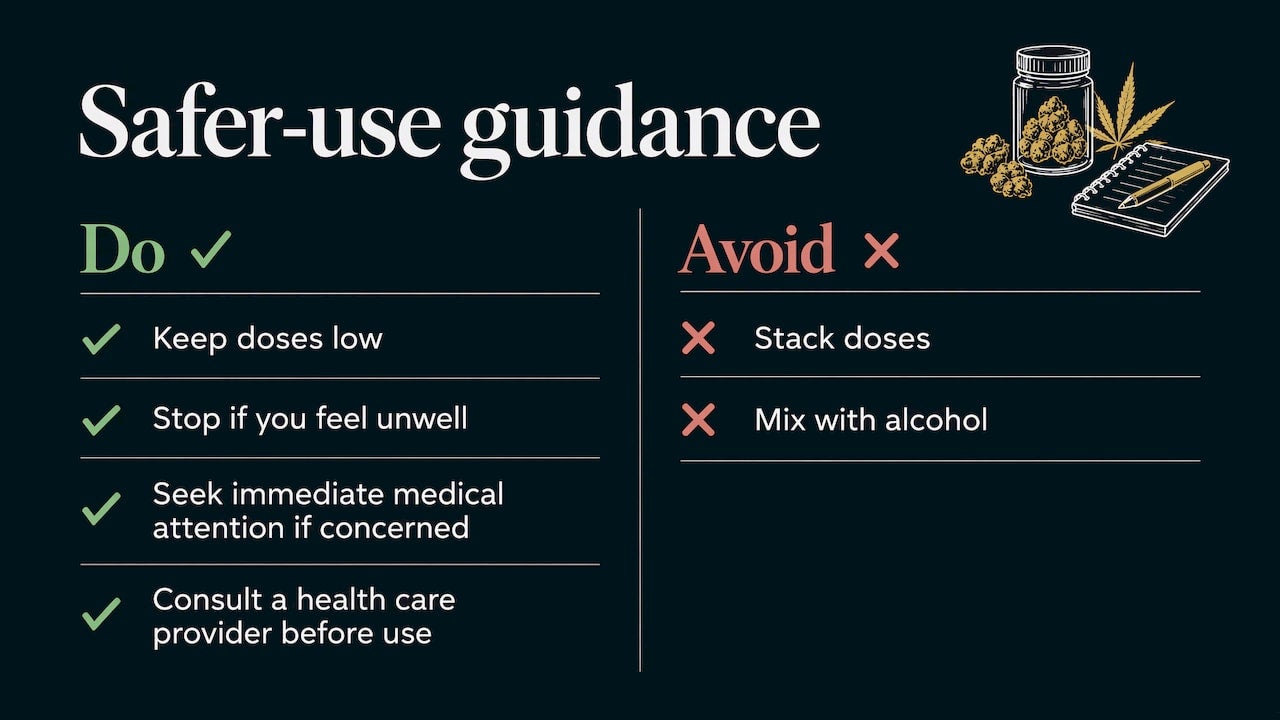
The practical response is simple: keep doses low, avoid stacking doses, avoid mixing with alcohol, and stop if you feel unwell. If side effects are concerning, Health Canada says to stop and seek immediate medical attention, and to call 9-1-1 in an emergency.
Legal Canadian cannabis products have also not been reviewed or authorized to treat specific diseases or symptoms, according to Health Canada’s medical cannabis overview, which advises consulting a health care provider before use. If you have an anxiety disorder, are taking medication, or have a family history of psychosis, make that conversation with your doctor or nurse practitioner your first step.
Our view on shopping for calm
We think the best anxiety-friendly shopping habit is to ignore the hype and read the label. Strain names change from grower to grower, but a printed THC and CBD amount is something you can compare and act on.
That is why we put detailed product information and customer reviews on our listings, and why we keep live chat and a help center open for questions. Our range covers flower, edibles, vapes, concentrates and CBD, so a new user can begin with a CBD product or a low-dose edible and move at their own pace without being pushed toward anything stronger.
Our advice to every first-time buyer: choose one product, take a small amount, wait, and write down how it went. Calm comes from control, and control starts with knowing what you are taking.
the author
Shop calmer, with support
If you are an adult in Canada ready to choose, we carry flower, edibles, vapes, concentrates, CBD and topicals, with delivery across the country. Start with the CBD and topicals selection if you want no intoxication, or browse edibles if you want measured doses. Each listing shows detailed information and reviews, and our live chat team can help you read a label before you order.
Bulk deals and on-sale items are listed on the site for regular shoppers.
When to talk to a professional
CAMH states there is no good evidence that cannabis provides long-term relief for anxiety or depression, and that stronger THC doses can produce anxiety, paranoia and panic. See a doctor or nurse practitioner if:
- your anxiety is severe, constant or getting in the way of work or relationships;
- you notice anxiety, panic or paranoia after using cannabis, more than once;
- you take prescription medication for anxiety, depression or any other condition;
- you have a personal or family history of psychosis or other mental health disorders.
In an emergency, such as intense panic with chest pain, confusion or thoughts of self-harm, call 9-1-1.
FAQ
What is the best cannabis strain for anxiety?
There is no single proven best strain. Look for CBD-dominant or balanced CBD and THC products with low THC, because THC at high doses is linked to more anxiety. Start with a small amount and track how you feel.
Is indica or sativa better for anxiety?
The labels are a loose guide at best. The cannabinoid amounts and terpene profile predict the experience more reliably than the indica or sativa tag. Read the THC and CBD numbers first.
How long does cannabis-induced anxiety last?
It depends on how you consumed it. Health Canada says inhaled effects can last up to 6 hours and ingested effects up to 12 hours, with residual effects up to 24 hours. If symptoms are intense or frightening, stop using cannabis and seek medical attention.
Can CBD alone help with anxiety?
Health Canada’s expert committee found some early evidence that CBD may help with short-term, mild stress and nervousness in healthy adults. For severe anxiety it says practitioner supervision is needed, so involve your doctor.
How much THC should a beginner take?
Health Canada advises new consumers to choose an ingested product with 2.5 mg THC or less and to wait up to 4 hours before taking more. Never combine with alcohol, and avoid driving after use.
Sources
- Health Canada: Choosing a cannabis product
- Health Canada: Cannabis for medical purposes, general information
- CCSA: Clearing the Smoke on Cannabis, 2024 update
- THC, CBD, and Anxiety: A review of recent findings
- Cannabis, a cause for anxiety? A critical appraisal
- Health Canada: Cannabis and mental health
- Journal of Cannabis Research: Naturalistic examination of anxiolytic effects
- Frontiers in Neuroscience: Cannabis and the Anxiety of Fragmentation
- Health Canada: Review of cannabidiol, Science Advisory Committee report
- The differential effects of medicinal cannabis on mental health (PubMed)
- Health Canada: What you need to know if you choose to consume cannabis
- HealthLink BC: Cannabis use
- CAMH: Do You Know… Cannabis
- Health Canada: Information on the use of cannabis for medical purposes
- Health Canada: Cannabis health warning messages
Recommended
- Discover the Best Cannabis Strains for a Restful Night’s Sleep
- Unveiling the Mysteries of Cannabis Strains: Your Go-To Guide for Finding the Perfect Match
- Cannabis Sativa vs. Indica vs. Hybrid: Understanding the Differences
- Rise and Shine: Discovering the Perfect Cannabis Strains to Start Your Morning Right
