
Articles
Cannabis for Nausea: What Works and How to Use It Safely

Nov
Some people find cannabis helps settle nausea, and the research points in the same direction for one situation in particular: nausea and vomiting after chemotherapy. Format matters. Inhaled cannabis acts within minutes, while edibles take much longer but last longer. Dose matters more still, because too much THC can bring on nausea instead of easing it. This guide covers what the evidence shows, how each format behaves, how to read a label, and when nausea needs a doctor first.
TL;DR
- Health Canada says research is limited but suggests cannabis might relieve severe nausea and vomiting from cancer chemotherapy that does not respond to conventional treatment.
- Inhaled products act within minutes. Edibles can take 30 minutes to 2 hours to start and last 4 to 8 hours, so they call for patience.
- Start with a very low dose, such as 2.5 mg of THC or less in an edible, and wait before taking more.
- Too much THC can cause nausea and vomiting. Frequent long-term use can lead to cannabinoid hyperemesis syndrome, which needs medical attention.
- Persistent or severe nausea, or nausea with warning signs, belongs with a doctor or an emergency service.
Table of Contents
- What the evidence says about cannabis and nausea
- How THC and CBD may act on nausea
- Inhaled or edible: how timing changes the choice
- Choosing a product for nausea
- A low and slow routine
- Order from home when you are unwell
- Our perspective
- When nausea needs a doctor
- FAQ
- Sources
What the evidence says about cannabis and nausea
Nausea is one of the better-studied symptoms in cannabis research, but “studied” does not mean “settled”. The strongest data come from people having chemotherapy, not from the stomach bug or morning queasiness most readers search about.
Chemotherapy-induced nausea and vomiting
Health Canada’s information for health care professionals says pre-clinical studies show that THC, CBD, THCV and CBDV, along with the acid forms THCA and CBDA, suppress acute and anticipatory nausea and vomiting. It adds that clinical studies suggest certain cannabinoids may give relief from chemotherapy-induced nausea and vomiting (CINV), though the evidence is limited.
The clinical numbers are encouraging in places:
- A Cochrane review of 23 randomized trials found that more people had no nausea and vomiting with cannabis-based medicines than with placebo, with a relative rate of 2.9. The same review noted more side effects such as feeling high, dizziness and sedation.
- A Canadian review of systematic reviews pooled seven trials and found a relative risk of 3.60 for control of nausea and vomiting after chemotherapy, with a number needed to treat of 3. The authors rated the certainty of that benefit low or very low.
- A 2024 placebo-controlled trial in the Journal of Clinical Oncology tested oral THC:CBD capsules (2.5 mg each) as an add-on. The complete response rate rose from 8% to 24% among 147 evaluable participants, with more sedation, dizziness and transient anxiety.
The cautious reading comes from the expert panels. The MASCC guidance, based on 36 trials, found that THC and nabilone prevented CINV better than placebo but were not more effective than other antiemetics. A 2025 systematic review of 32 studies reached a similar view: the clinical evidence is insufficient to recommend cannabinoids as a standard CINV treatment. The practical takeaway is that cannabinoids look most useful as an add-on when standard anti-nausea medication is not enough, and that decision belongs to your oncology team.
The Canadian Centre on Substance Use and Addiction also notes that nabilone is a prescription cannabinoid approved in Canada for CINV. If you are in treatment, ask your care team about it before anything else. For more on the cancer context, see our piece on cannabis in cancer treatment.
Everyday nausea
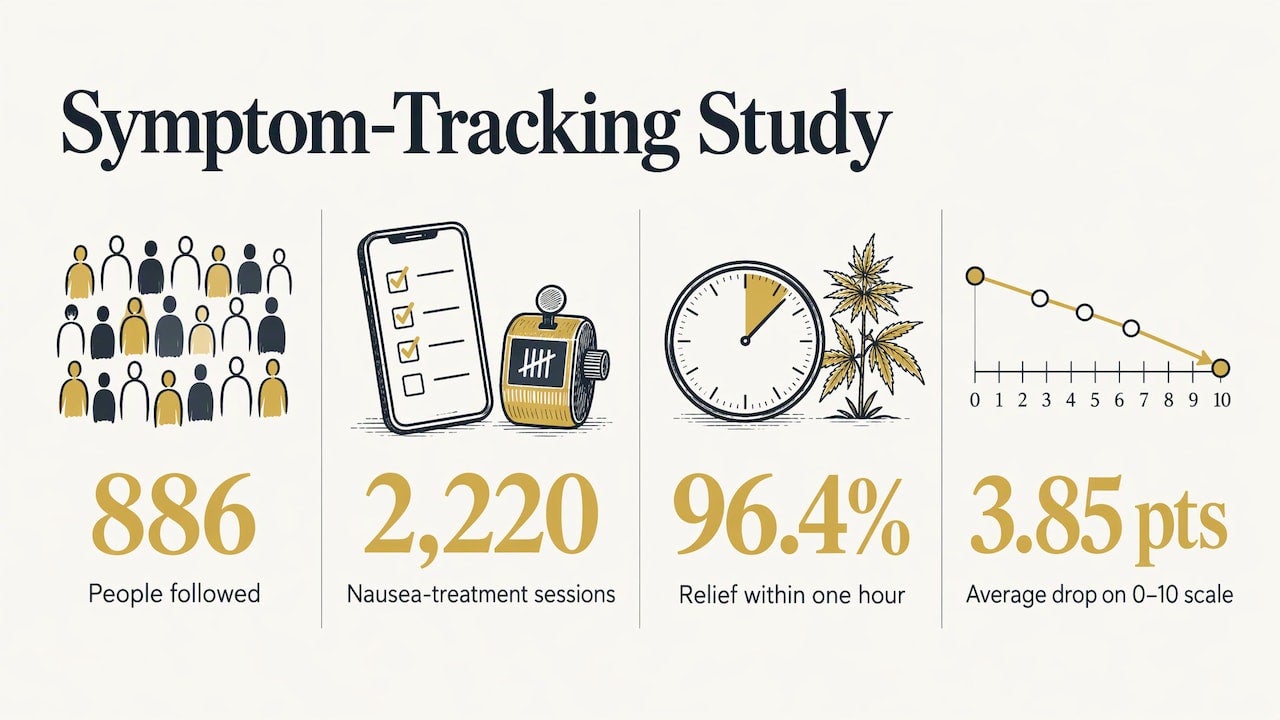
For nausea outside chemotherapy, controlled trials are scarce. One large data set comes from users themselves. A 2022 study using a symptom-tracking app followed 886 people over 2,220 sessions intended to treat nausea. 96.4% reported relief within an hour, with an average drop of 3.85 points on a 0 to 10 scale, and flower and concentrates gave the strongest results. Self-reported data cannot show cause and effect, but it matches what many adult consumers describe.
Health Canada is plain on the regulatory side: it has not authorized cannabis products to treat any specific disease or symptom. Use is a personal choice for adults, best made with a health care provider when a medical condition is involved.
How THC and CBD may act on nausea
THC is the cannabinoid with the most data behind it for nausea. CBD and the minor cannabinoids are also being studied. Health Canada’s HCP document sets out the pre-clinical picture above, and the Arthritis Society Canada notes that THC in small doses can help with some symptoms, including nausea. The same page says higher doses can heighten sensory perception, alter the sense of time and bring anxiety or paranoia for some people.
That is the central idea of this whole guide: with nausea, a small, well-timed dose is the goal. If you want a deeper primer on the two main compounds, read what CBD and THC are and how THC and CBD differ.
What about terpenes?
Readers often ask which terpene is best for nausea. Health Canada says relatively little is known about what terpenes do in the body, that terpene content varies widely among cannabis varieties, and that the idea terpenes enhance cannabinoid effects remains a hypothesis with no clinical trials behind it. So no terpene can be named as a proven nausea fix. If a terpene profile is listed on a product page, treat it as one more detail to note about how a product smells and feels for you, and keep track of what works.
Inhaled or edible: how timing changes the choice
When you are nauseated, speed and predictability matter. Swallowing a gummy while queasy is also not always practical. Here is how the formats compare, using Canadian guidance.
| Format | When it starts | How long it lasts | What to keep in mind |
|---|---|---|---|
| Inhaled (flower, vape) | Within minutes | Shorter | Take one small puff, then wait a few minutes before another |
| Edibles (gummies, chocolate, drinks) | 30 minutes to 2 hours | Effects can last 4 to 8 hours | Strongest effects may arrive after 2 to 4 hours |
| Tinctures and capsules | Taken by mouth, so expect timing similar to edibles | Longer | Follow the label dose and wait before repeating |
The onset figures for edibles come from Health Canada, which says effects start within 30 minutes to 2 hours, may peak after 2 to 4 hours and can last 4 to 8 hours, depending on the product, other oral medications and what is in your stomach. The CCSA gives a wider window for some people, noting that edible effects can peak at about four hours and last up to 12 hours, with residual effects up to 24 hours.
There is also a trap here. The CCSA warns that because full effects can take up to four hours, taking more too soon can lead to over-intoxication, including anxiety, panic, and nausea and vomiting. Too much, too fast is the most common way to turn a nausea remedy into a nausea problem.
Health Canada also states that impairing effects can last at least six hours or longer depending on the method of consumption, so plan for no driving and a quiet evening.
Choosing a product for nausea
Health Canada says there is not enough scientific information to recommend which product to take for any specific condition, and that you and your provider will use trial and error. That is useful permission to be methodical: change one thing at a time and keep notes.
Flower and vapes: fast, easy to adjust
Because inhaled effects arrive quickly, you can adjust in small steps. That makes cannabis flower and vapes and refills the usual starting point for people who need relief on a short timeline. Many people look at sativa or hybrid options, and our guide to sativa, indica and hybrid differences explains what those labels do and do not tell you. The app study above found joints gave greater relief than pipes or vaporizers, though that was self-reported and every person responds differently.
Edibles: slower, longer, easy to overdo
Gummies and chocolates suit planned use, for example when nausea is predictable and you can take a dose well ahead of time. Browse cannabis edibles with the timing table above in mind.
What to check on the label:
- THC per piece and per package. Health Canada says the front of the label must show total THC and total CBD. Edibles in Canada are limited to 10 mg of THC per package, so a licensed product should never exceed it.
- The ingredient list. It is listed by descending weight, and food allergens, gluten and added sulphites must be declared on edible cannabis. This matters if a sensitive stomach is part of your problem.
- The serving size. Work out how much one gummy contains before you take it, then cut or split to reach a low dose.
CBD: a gentler place to begin
The Arthritis Society Canada suggests that first-time medical users start with a CBD-dominant product at the lowest dose and increase gradually. If you prefer to avoid THC at first, look at CBD and topicals, such as CBD capsules or a CBD tincture. Evidence for CBD alone on nausea in people is thinner than for THC, so keep expectations modest and your notes honest.
A low and slow routine
Health Canada’s guidance for professionals says dosing is highly individual and relies on titration. People with no prior experience should start at a very low dose and go slowly, waiting a few minutes between puffs and 30 to 60 minutes between bites of oral products. Here is a simple way to apply that.
- Pick one product and one format. Do not mix inhaled and edible on your first tries.
- Start tiny. For an edible, the CCSA and the Ontario Cannabis Store both advise 2.5 mg of THC or less for new consumers. For inhaling, one small puff.
- Wait. A few minutes for inhaled, at least two hours for an edible before considering more.
- Write it down. Product, dose, time, how you felt at one hour and at four hours.
- Change one variable at a time. Dose first, then format, then product.
- Eat lightly and sip fluids. Food in the stomach changes edible timing, so stay consistent from one trial to the next.
If you take other medications, talk to your pharmacist first. The CCSA notes that cannabis can interact with medications for pain, colds and flu, seizures, depression, anxiety, sleep and allergies, among others.
Order from home when you are unwell
When you feel sick, a shop trip is the last thing you want. We carry flower, edibles, vapes, concentrates, CBD and accessories, with product details and customer reviews on each page so you can compare before you order. Our live chat support and help center are there if you are unsure about a label or format, and our guide to the benefits of cannabis delivery explains how shopping online works for people who would rather not go out.

Start with the edibles or flower pages, or head to the FV Buds homepage to browse everything. Orders are for adults in Canada.
Our perspective
Most people who come to us asking about nausea do not need a lecture about cannabis. They need clear information, a sensible starting point and someone to answer questions at the moment they have them.
Our view is that format and dose decide the experience more than any single strain name. That is why we publish detailed product information and customer reviews, and why we offer live chat support: a person comparing a low-dose gummy with a vape cartridge should be able to ask a real question and get a real answer before ordering.
We also think a wide selection serves people better than a narrow one. Someone who finds inhaling too harsh when queasy may do better with an edible planned ahead of time, and someone wary of THC may want to begin with CBD. Having flower, edibles, vapes, concentrates and CBD in one place makes that kind of careful, step-by-step trial easier.
Used with care and a low starting dose, cannabis can be a thoughtful part of how an adult manages how they feel.
the author
When nausea needs a doctor
Cannabis is not a substitute for finding out why you are sick. Santé Québec advises seeking medical attention for nausea lasting more than 24 hours without improvement or if you cannot keep your regular medications down. Go to the hospital right away for:
- fever if you are immunocompromised, pregnant, or caring for an infant under 3 months
- vomit containing blood
- repeated projectile vomiting
- vomiting with a stiff neck or intense headache
- constant abdominal pain that worsens when touched
- severe chest pain
The CCSA also says there is not enough evidence to support using any form of cannabis for nausea and vomiting in pregnancy. If you are pregnant, talk to your doctor or midwife.
Cannabinoid hyperemesis syndrome
This is the other side of the story. Health Canada lists cannabinoid hyperemesis syndrome (CHS) as a possible effect of THC and of long-term use: repeated episodes of severe nausea, intense and prolonged vomiting, and stomach pain that resists treatment. Some people call it scromiting. If cannabis seems to be making your nausea worse, or you have the pattern of daily use followed by cycles of vomiting, stop and see a doctor. Alberta Health Services says people usually feel better within 10 days of stopping completely, and advises calling Health Link at 811 if you feel dizzy or cannot keep fluids down.
Call 9-1-1 for seizures, chest pain, trouble breathing, loss of consciousness or hallucinations.
FAQ
Does weed help with nausea?
Many adults report that it does, and some clinical trials show benefit for chemotherapy-related nausea. Health Canada describes the research as limited and has not authorized cannabis for any specific symptom. Start with a very low dose and speak with a health care provider if the nausea is persistent.
What kind of gummies are good for nausea?
No gummy is proven for nausea, so choose for control. Pick a product with clear THC per piece on the label, split pieces to reach about 2.5 mg of THC, and check the ingredient list for allergens. Wait at least two hours before taking more.
What relieves nausea fast?
Inhaled cannabis acts within minutes, while edibles may take up to two hours to start. For general nausea, sipping fluids, resting and eating bland food are common first steps. See a doctor if it lasts more than 24 hours or you have warning signs.
What terpene is best for nausea?
None can be named with confidence. Health Canada says little is known about terpene actions and that the claim they boost cannabinoid effects has no clinical trials behind it. Focus on THC and CBD content, format and dose.
Can cannabis make nausea worse?
Yes. Taking too much, especially of an edible, can cause nausea and vomiting, and long-term frequent use can lead to cannabinoid hyperemesis syndrome. If your symptoms get worse after use, stop and seek medical advice.
Sources
- Health Canada: Cannabis for medical purposes, general information
- Health Canada: Information for health care professionals on cannabis and cannabinoids
- Cochrane review: cannabis-based medicine for nausea and vomiting after chemotherapy
- Systematic review of systematic reviews for medical cannabinoids
- Oral cannabis extract trial, Journal of Clinical Oncology
- MASCC guidance on cannabinoids in supportive care
- Systematic review of cannabinoids for chemotherapy-induced nausea (2025)
- CCSA: research on treating medical conditions with cannabis
- Effectiveness of common cannabis products for nausea (PubMed)
- Arthritis Society Canada: Medical cannabis, CBD and THC
- Health Canada: Using a cannabis product
- CCSA: 7 Things You Need to Know about Edible Cannabis
- Information for health care professionals (Veterans Affairs Canada)
- Health Canada: Choosing a cannabis product
- Health Canada recall alert on gummy-like edibles
- Health Canada: How to read a cannabis product label
- Santé Québec: Nausea and vomiting
- Health Canada: Cannabis side effects
- Alberta Health Services: Cannabinoid hyperemesis syndrome care instructions
Recommended
- Navigating the Haze: Investigating the Potential Benefits of Cannabis in Cancer Treatment
- The Surprising Health Benefits of Cannabis: Exploring its Medicinal Potential
- A Silver Lining: Cannabis Consumption for Seniors
- The Ultimate Elixir: Incorporating Cannabis Oil into Your Daily Routine
