
Articles
Cannabis for Insomnia: How to Choose Products and Use Them Well

Nov
If you are looking at cannabis for insomnia, the choice that matters most is the product, not the hype around it: a low-dose edible or oil taken early enough, a flower chosen by its listed THC and CBD content rather than its name, and a start low, go slow routine. This guide walks through each of those decisions for adults in Canada, from what the cannabinoids do to how long an edible takes to work. It also explains where to find the products and the help you need to pick one with confidence.
TL;DR
- THC, CBD and CBN are the three cannabinoids people most often look at for sleep; CBD and CBN are the ones studied at set doses, and a 2026 review put useful ranges at 50 to 300 mg of CBD and 20 to 100 mg of CBN.
- Edibles take 30 minutes to 2 hours to start and can last 12 hours or more, so take them well before bed and wait before adding more.
- Strain labels such as indica and sativa are only a starting point. The THC and CBD numbers on the product page tell you far more.
- In Canada, edibles are capped at 10 mg of THC per unit, which makes small, repeatable starting doses easy.
- Do not drive or do anything that needs alertness the next morning until you know how a product leaves you feeling. Drowsiness can last up to 24 hours.
Table of Contents
- Why people turn to cannabis when they cannot sleep
- THC, CBD and CBN: what each is used for
- What Canadian patients report
- Choosing a format for sleep
- Edibles for sleep: timing is the whole game
- Strain names: how much do they tell you?
- How to start, step by step
- Safe use: what to know before the first night
- Where to buy and what to expect
- Our point of view
- FAQ
- Sources
Why people turn to cannabis when they cannot sleep
Insomnia is one of the most common reasons Canadians give for using cannabis medically. The Canadian Centre on Substance Use and Addiction (CCSA) names it as a common medical reason for cannabis use in Canada in its 2024 update, and it notes that short-term THC use may help sleep.
The reasons make sense. Insomnia usually means one or more of three problems: taking too long to fall asleep, waking during the night, or waking too early. Different cannabis products are used for different parts of that pattern, which is why one person reaches for a gummy and another for an oil or a bit of flower.
The short-term picture for THC, as summarized in a review of cannabinoids and sleep, is more sleep consolidation, a shorter time to fall asleep and more total sleep time. The same review also describes the other side: chronic daily THC use is linked with longer time to fall asleep and more waking in the night. That is the reason the rest of this article leans on timing, small doses and a sensible routine.
THC, CBD and CBN: what each is used for
The three names come up on almost every sleep product label.
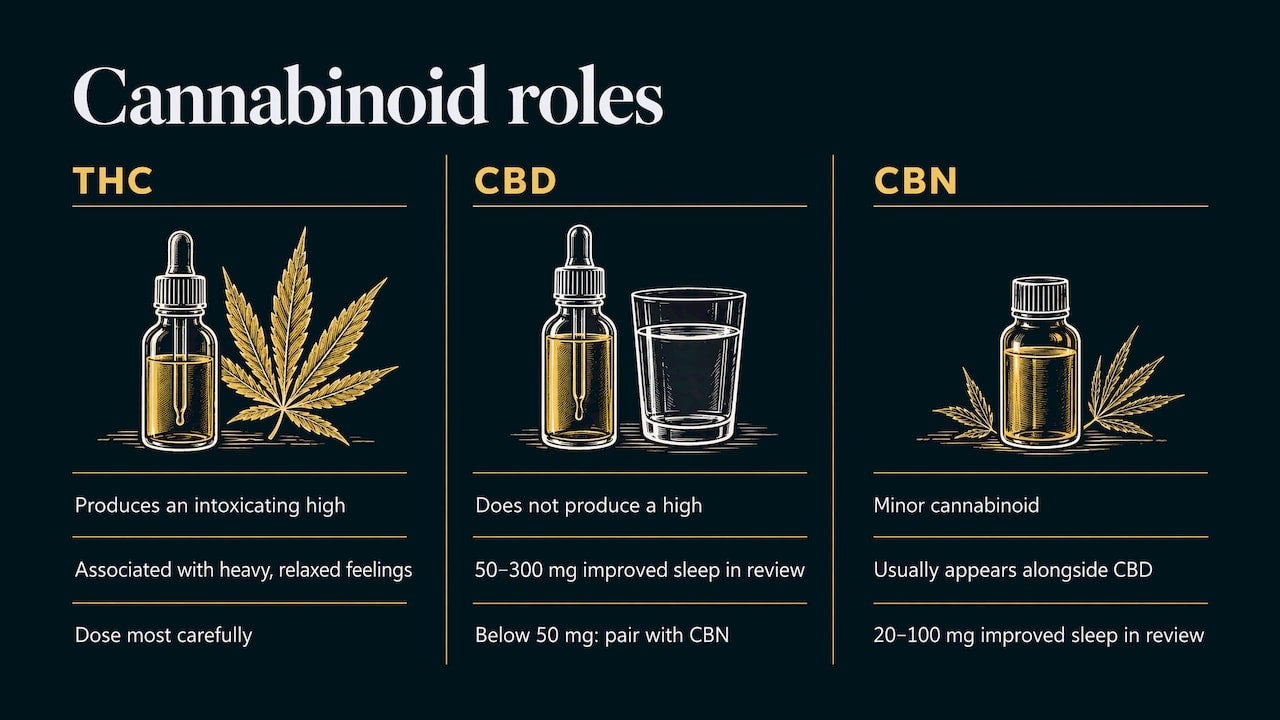
THC is the cannabinoid that produces the high. In sleep products it is the one most associated with feeling heavy and relaxed in the evening. Because it is the intoxicating one, it is the one to dose most carefully.
CBD does not produce a high. People choose it when they want to wind down without feeling impaired. If you want a plain-language comparison, our guide to the difference between THC and CBD covers how they act differently, and the CBD and THC benefits and risks page goes through each in more detail.
CBN is a minor cannabinoid that shows up in products marketed for night-time use, usually alongside CBD.
A 2026 systematic review and meta-analysis on medical cannabis for insomnia in adults found that CBD at 50 to 300 mg and CBN at 20 to 100 mg were safe and effective for improving sleep. It also found that CBD below 50 mg worked only when paired with CBN, and it advised people treating themselves to begin with low-dose CBN or a CBN and CBD blend. That is a useful map for a first purchase: if you want to avoid a high, start in the CBD and CBN range, and read the label for milligrams per unit.
What Canadian patients report
Real-world Canadian data gives a feel for how people actually use these products.
In a 2022 chart review from a pharmacy in Ottawa, 38 patients using medical cannabis for sleep had adequate follow-up. Of them, 71% reported better sleep, and 39% (15 patients) cut back or stopped a prescription sleep medication. Only 8 patients (21%) reported adverse effects, and these were manageable: diarrhea, acid reflux, anxiety at higher THC levels and brain fog. Adjusting the product, changing the THC to CBD balance or lowering the dose was enough to manage them.
The same study shows how people structure their routine. Many used a high-CBD oil during the day and a 1:1 THC to CBD oil at night. One third (34%) used CBD-only oil and 21% used a THC and CBD combination.
A Canadian study of 299 patients over 50 found that almost all preferred oral products, such as extracts and edibles, high in CBD and low in THC. Their sleep scores on the Pittsburgh Sleep Quality Index improved from 10.86 at the start to 8.51 at six months, and 45% (100 of 224) showed clinically meaningful improvement. No serious adverse events were reported.
Two patterns stand out. People tend to land on oral products with a measured dose, and they tend to keep THC modest. Both are easy to follow when you shop with the numbers in front of you.
Choosing a format for sleep
The way you take cannabis changes when it starts and how long it lasts. Here is how the main formats fit a sleep routine.
| Format | How it tends to fit sleep | What to watch |
|---|---|---|
| Edibles (gummies, chocolate, candy, beverages) | Measured dose per piece, long-lasting effect through the night | Slow onset, so patience matters |
| Tinctures and oils | Easy to adjust by small amounts; the format most used in the Canadian studies above | Measure with the dropper every time |
| Flower | Familiar, and you choose the cultivar | Dose is harder to measure |
| Vapes and refills | Quick to take, with an easy way to take a small amount | Easy to overdo if you take several puffs in a row |
| CBD products | Non-intoxicating option for winding down | Check milligrams per serving |
A Canadian naturalistic study using the Strainprint app, covering 8,476 recorded sessions from 677 users, found that dried flower and oral oil were the most used forms for insomnia and the ones users rated most effective. Those two formats are a reasonable place to start your shortlist, with edibles as the measured-dose alternative.
Edibles for sleep: timing is the whole game
Edibles are popular for sleep because they last. That same quality is what catches new users out.
According to Active Aging Canada, edibles take 30 minutes to 2 hours to begin working, up to 4 hours for full effects, and can last 12 hours or more. Its guidance for a sleep soft gel is to take it at least 30 minutes before bedtime. The Eastern Ontario Health Unit gives the same onset window and advises that you start with a small amount and wait one hour before taking more.
Canadian rules help here. Edibles are limited to 10 mg of THC per unit or serving, they must show the dose in milligrams, and they must come in plain, child-resistant packaging with a standardized symbol and health warning. That means you can read the label, pick a small unit and know what you are taking.
A practical evening plan:
- Pick a time at least an hour before you want to be asleep.
- Take a low dose: for a THC edible, a fraction of one unit; for a CBD or CBN product, the low end of the label.
- Wait a full hour. Do not add more because you feel nothing at 30 minutes.
- Write down the product, the dose, the time and how you slept.
- Raise the dose only on a later night, and only by a small step.
The notebook is not a chore. It is how you find your own number, which is the thing the research cannot do for you.
Strain names: how much do they tell you?
Shoppers often search for strains for sleep, and indica is the label most associated with the evening. It is a reasonable place to begin. In the Strainprint study, among people with depression, indica-dominant, indica hybrid and sativa-dominant strains were rated significantly more effective for insomnia than CBD-dominant strains. In people with anxiety, no differences between strain categories were found.
What this tells you is that your own response counts as much as the label. Use the strain name as a first filter, then compare what the product page lists: THC percentage, CBD percentage and the product type. If you want a curated starting point, read our guide to cannabis strains for a restful night’s sleep, then browse the flower category, where each product has detailed information and customer reviews to compare.
How to start, step by step
Step 1: Decide what you want to avoid. If you do not want a high, begin with CBD or a CBD and CBN blend. If you are comfortable with some THC, keep it low.
Step 2: Choose a format that matches your night. Trouble falling asleep suits something that starts in a reasonable window; waking at 3 a.m. is why many people choose an edible or oil taken before bed. Our live chat is there to help you match a format to your pattern when you are unsure.
Step 3: Read the label in milligrams. Look for the milligrams of THC, CBD or CBN per unit, not just the package total. A pack with a large total can still be dosed in small pieces.
Step 4: Start with the smallest dose. The Eastern Ontario Health Unit’s advice to start small and wait is as useful for sleep as for anything else.
Step 5: Keep the room and routine the same. Same bedtime, dark room, no screens. Change one thing at a time so you know what is helping.
Step 6: Review after a week. Look at your notes. If a dose is working, stay there. If you wake groggy, lower it.
Safe use: what to know before the first night
Some points matter more than any product choice.
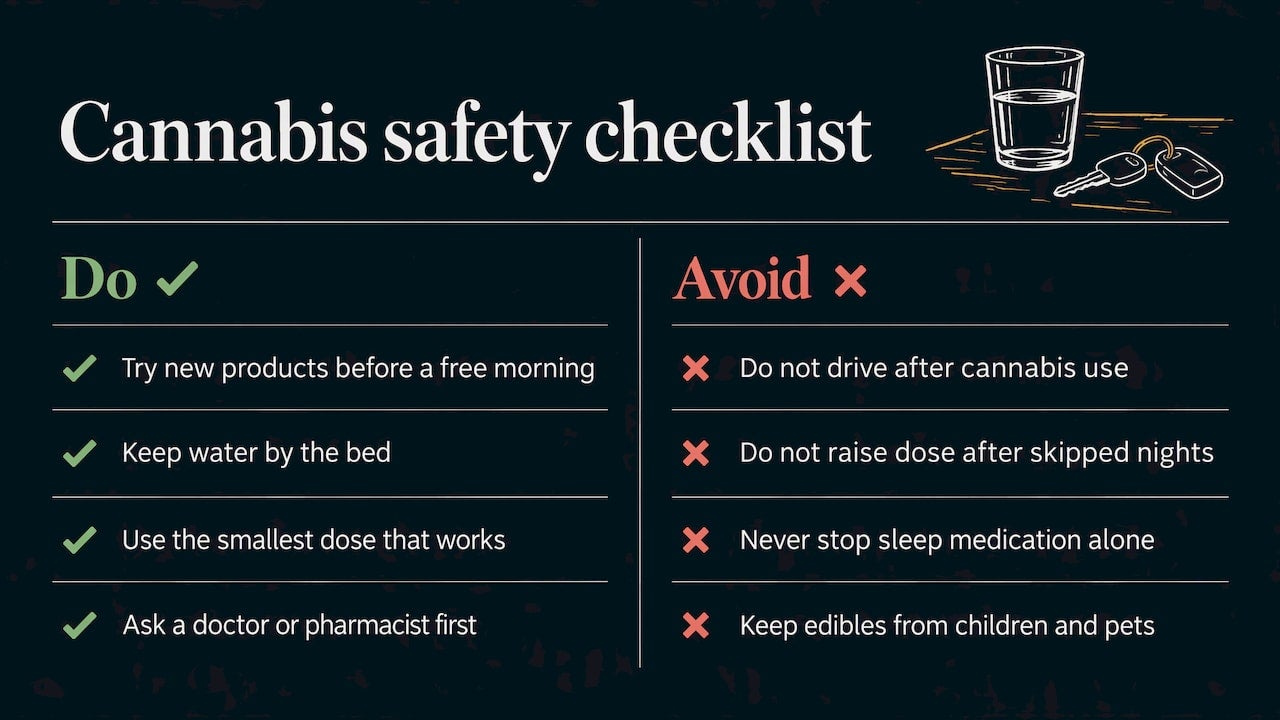
Next-day drowsiness and driving. Active Aging Canada notes that drowsiness from cannabis can last up to 24 hours, well after other effects fade, which makes driving after use especially hazardous. Try a new product on a night when you do not have to be anywhere early.
Common mild effects. A 2022 meta-analysis in the journal Sleep reported small increases in dizziness, somnolence, dry mouth, fatigue and nausea among people using medical cannabis. Keep water by the bed and stand up slowly in the night.
Higher doses bring more side effects. A systematic review of 31 studies on dosing found headaches, sedation and dizziness more often at higher doses. This is the strongest argument for the smallest dose that works.
Nightly use and stopping. Sleep disturbance and vivid dreams are a feature of stopping cannabis, usually beginning 24 to 72 hours after the last use and lasting up to 6 to 7 weeks. If you notice your sleep gets worse on nights you skip, that is a sign to review your routine with a doctor rather than raise the dose.
Older adults. The same Active Aging Canada booklet warns that people who start cannabis later in life face a higher risk of overconsumption because they lack experience with products. If you are over 50, the lower-THC, higher-CBD oral products in the Canadian study above are the natural place to start.
Medications and health conditions. If you take prescription sleep medication, other sedating medication, or you have a heart, mental health or liver condition, talk to your doctor or pharmacist before you start. The Ottawa study credits the pharmacist’s role in follow-up and medication management. Also see a doctor if sleeplessness has lasted weeks, or if you snore loudly or stop breathing in the night, since those can point to a sleep disorder that needs its own assessment. Never stop a prescription sleep medication on your own.
Legal side. In Canada, cannabis is not an approved therapeutic product, and medical use requires a medical document from a health care practitioner. The CCSA’s 2024 update lays out that framework. Adult-use products are for adults only, and edibles must stay in their child-resistant packaging, out of reach of children and pets.
Where to buy and what to expect
FV Buds is an online cannabis dispensary for adults across Canada. For sleep, the relevant shelves are edibles in candy, gummy, chocolate, tincture and beverage forms, flower in indica, sativa and hybrid, vapes and refills, and CBD and topicals. Each product page carries detailed product information and customer reviews, so you can read the numbers and other buyers’ experiences before you order.
If you are new, the live chat and the help center are there for questions in real time, such as how to read a label or which format suits a first night. Orders ship across Canada, and the site lists bulk deals and on-sale items.

Ready to build your evening routine? Start with the edibles category for measured doses, or browse flower if you prefer to choose by cultivar.
Our point of view
Most people who write to us about sleep are not looking for the strongest product. They want a routine they can repeat. That is why we point people to the label first: milligrams, product type, and a small starting dose.
Our catalogue is built so you can do that. Flower, edibles, concentrates, vapes and CBD products each come with detailed information and customer reviews, so you can compare before you decide. If a label or a dose is unclear, live chat and the help center are there so you do not have to guess.
The Canadian research on sleep points the same way: oral products, modest THC, and attention to timing. Our edibles and CBD ranges suit that approach, and our flower range suits those who prefer to choose by strain. Start low, keep notes, and let your own results guide the next order.
the author
FAQ
Which cannabis strains are best for sleep?
Most people start with indica or indica-hybrid flower for the evening. In one Canadian study of people with depression, those strain types were rated more effective for insomnia than CBD-dominant strains. Treat the name as a starting point and compare the THC and CBD figures on each product page.
Are edibles a good choice for sleep?
Many people choose edibles because the effect lasts through the night and each piece has a labelled dose. Canadian edibles are capped at 10 mg of THC per unit. Take them at least 30 minutes to an hour before bed, and wait a full hour before taking more.
Can I use weed for insomnia every night?
Short-term use is the pattern most associated with easier sleep, while frequent use has been linked with longer time to fall asleep. Stopping can also disturb sleep for days to weeks. Keep to the lowest dose that works, and talk to your doctor if you find you need it every night.
Is CBD enough, or do I need THC?
That depends on whether you want to avoid a high. A 2026 review found CBD at 50 to 300 mg and CBN at 20 to 100 mg to be safe and effective for sleep. CBD under 50 mg worked only with CBN added. Many Canadian patients also use a 1:1 THC to CBD oil at night.
Should I check with a doctor first?
Yes, if you take prescription sleep or other sedating medication, have a medical condition, or have had insomnia for several weeks. A doctor or pharmacist can review interactions and follow up with you. Medical use in Canada requires a medical document from a health care practitioner.
Sources
- Cannabis use in patients with insomnia and sleep disorders (Ottawa pharmacy chart review, 2022)
- Medical Cannabis for Patients Over Age 50: A Multi-site Prospective Study
- Medical cannabis for treatment of insomnia in adults: systematic review and meta-analysis
- Clearing the Smoke on Cannabis: Medical Use of Cannabis and Cannabinoids (CCSA, 2024)
- Effects of Cannabinoids on Sleep and their Therapeutic Potential
- An investigation of cannabis use for insomnia in depression and anxiety
- Cannabis dosing and administration for sleep: a systematic review
- Medical cannabis and cannabinoids for impaired sleep: a systematic review and meta-analysis
- Be Wise: Cannabis and Older Adults Booklet (Active Aging Canada)
- Cannabis and Your Health (Eastern Ontario Health Unit)
- Health considerations of the legalization of cannabis edibles
Recommended
- Discover the Best Cannabis Strains for a Restful Night’s Sleep
- Edibles for Pain: How to Choose, Dose and Use Them Well
- Cannabis Sativa vs. Indica vs. Hybrid: Understanding the Differences
- Unveiling the Mysteries of Cannabis Strains: Your Go-To Guide for Finding the Perfect Match
