
Articles
CBD Topical for Pain: How to Choose and Use It in Canada

Nov
A CBD topical is a cream, balm, lotion or salve you rub onto the skin over a sore spot, usually a joint or muscle. Many Canadians choose one because they want a targeted, smoke-free option. The research is still early, so the best approach is to pick a clearly labelled product, apply a small amount, and keep your expectations realistic. This guide covers what the science says, how the formats differ, how much to use, and what to look for on the label.
TL;DR
- Human research on topical CBD for pain is limited. Health Canada’s advisory committee said in 2022 that evidence is not yet enough to support or refute CBD for minor pain.
- Creams are lighter and absorb fast, balms are oil-and-wax based and stay put, and lotions sit in between. Choose by where you apply it and how it feels.
- Health Canada has no dosing guidance for topicals. Start with a thin layer on a small patch of skin and talk to a health care provider about a starting amount.
- Read the label for CBD and THC content per unit, a batch or lot number and the ingredient list. Cannabis topicals in Canada are sold through authorized channels.
Table of Contents
- Is a CBD topical good for pain?
- Cream, balm, lotion or salve: which format fits
- How to use CBD cream for pain
- What to check on the label and the package
- Safety: who should talk to a professional first
- The rules for buying CBD topicals in Canada
- Our perspective
- Shop CBD topicals across Canada
- FAQ
- Sources
Is a CBD topical good for pain?
The honest answer is that it may suit some people, and science has not settled it. Here is what the main studies found.
Health Canada’s Science Advisory Committee reviewed CBD in 2022 and concluded there is not yet enough scientific or clinical evidence to support or refute short-term use of CBD products for minor pain. The American Academy of Orthopaedic Surgeons likewise calls the current evidence inconclusive.
The most encouraging human data comes from a small trial. In a 2022 randomized trial from the University of Virginia, 18 people with thumb basal joint arthritis applied a CBD and shea butter preparation twice a day for 2 weeks. They had significant improvements in pain and disability and no adverse events. The authors asked for larger, multicenter trials to confirm the result and study dose response.
A 2022 review of topical cannabinoids for pain looked at 46 studies, 6 in humans and 40 in animals. The human studies reported no adverse events and preliminary signs of lower pain ratings. Another systematic review of skin-applied CBD found only 8 interventional human trials and said better-designed studies are urgently needed.
What this means in practice:
- Topical CBD has early, encouraging signals in specific situations, but the evidence base is small.
- Results from one product, dose or condition cannot be assumed for another.
- Individual experience varies, so treat a topical as one part of how you look after sore joints and muscles, alongside movement, rest and advice from your clinician.
If you want a longer look at the biology, our article on the science behind CBD pain relief goes deeper. For the basics of the compound itself, see what CBD and THC are.
Cream, balm, lotion or salve: which format fits
All of these are topicals, meaning they go on the skin and are not swallowed or inhaled. The difference is mostly the base, which changes texture, absorption feel and how long the product stays on the surface.
| Format | Typical base | Feel | Where it tends to suit |
|---|---|---|---|
| Cream | Water-based emulsion, often with oils | Light, absorbs quickly, little residue | Larger areas like the lower back, shoulders, thighs |
| Lotion | Thinner water-based emulsion | Spreads easily, lightest feel | Daily use over big areas, dry skin |
| Balm | Oils and waxes, little or no water | Thick, stays on the surface, can feel warm as you rub | Hands, knees, elbows, small targeted spots |
| Salve | Similar to balm, often a softer texture | Between cream and balm | Cracked or dry skin plus a sore joint |
These are general product-type differences, and individual formulas vary, so the ingredient list matters more than the name on the jar. A “hemp CBD balm” is simply a balm made with a hemp-derived or cannabis-derived CBD extract. In Canada, though, products containing CBD fall under the Cannabis Act, whatever plant they come from.
How to choose by situation
- Hands and fingers: a balm stays in place and does not wash off as easily as a lotion. Reapply after washing.
- Lower back or shoulders: a cream or lotion spreads over a wider area without a greasy finish.
- Gym or sport: many people like a cream for a quick-absorbing application before or after activity.
- Sensitive skin: pick the simplest ingredient list you can find and do a patch test first (see below).
- Scent: fragrance and essential oils are common in topicals and are a common cause of skin irritation. Unscented options are easier to start with.
How to use CBD cream for pain
Health Canada notes that for topical administration there is no dosage information and advises talking to a health care provider to choose a starting dosage. That is why the steps below are about method and caution, not a magic number.
- Patch test. Apply a pea-sized amount to a small area of inner forearm and wait 24 hours. Health Canada says topical cannabis may cause localized allergic reactions such as rashes and itching. If you see redness or itching, wash it off and stop.
- Clean, dry, unbroken skin. Do not apply to open wounds, rashes or irritated skin.
- Start small. Use a thin layer over the sore area. The AAOS suggests first-time CBD users minimize their dose until they know how they respond to a specific product.
- Massage in gently until it is absorbed. Rubbing for a minute or two helps spread a balm evenly.
- Wash your hands afterward, and keep the product away from eyes and mouth.
- Keep notes. Write down how much you used, where, how often and how the area felt. After a couple of weeks you will have a clear picture of whether it fits your routine.
- Reapply only as the label directs. Do not increase amounts because a product feels slow.
How much CBD cream should you use?
There is no established amount. The 2022 trial above used a twice-daily application over 2 weeks, but that was one study of one preparation in one joint, and it does not set a rule. Follow the directions printed on your product, start at the low end, and ask a pharmacist or physician to help set a starting amount, especially if you take other medications.
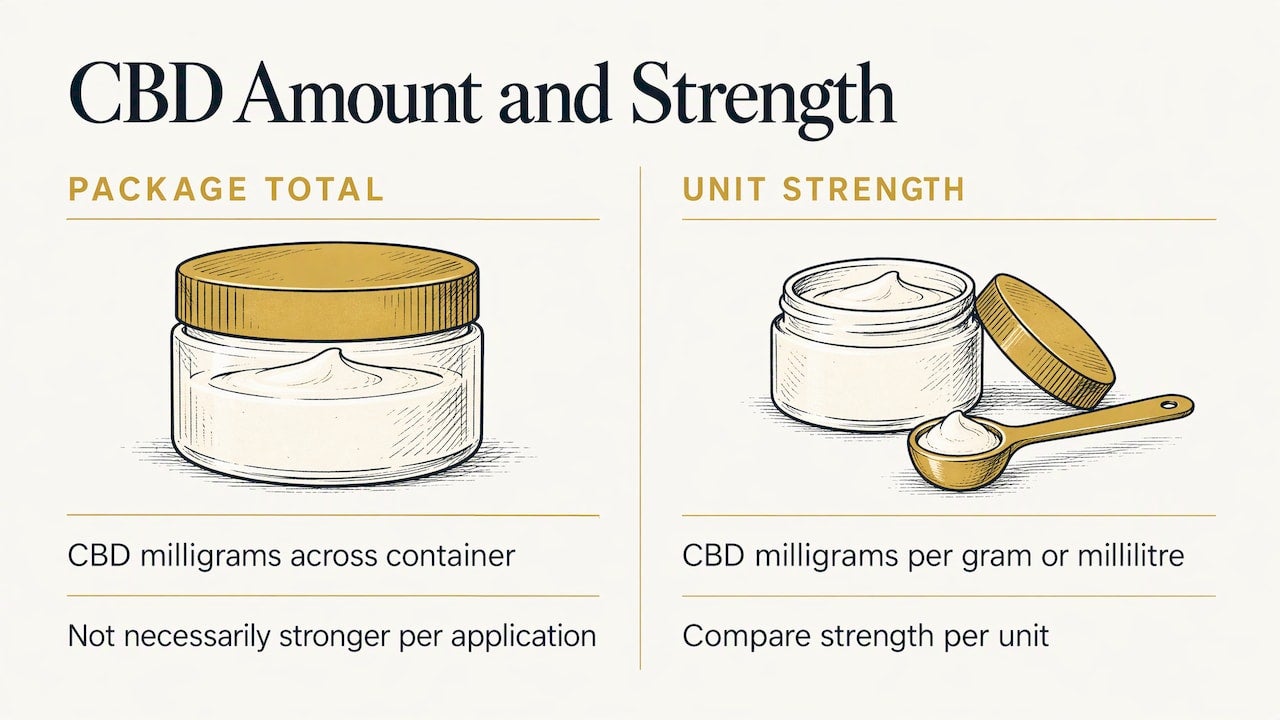
Also check the strength per unit. A product with a higher milligram total in a larger jar is not necessarily stronger per application, so compare mg of CBD per gram or per millilitre.
What to check on the label and the package
Quality is the biggest practical question. The AAOS says CBD products have no established quality standards, and that many contain a different amount of CBD than the label lists. Mayo Clinic cites a study of 84 products bought online in which more than a quarter had less CBD than labelled, and THC turned up in 18 of them.
Canada has its own examples. Health Canada has recalled lots where the label did not match testing, such as a topical roll-on in December 2021 whose label showed 3 mg of THC per unit while testing found 7.0 mg. That is why a careful buyer reads the label closely.
A useful checklist:
- CBD and THC per unit, clearly stated. Look for both numbers, in milligrams per package or per gram.
- Lot or batch number and a packaging date. It lets you follow a recall notice.
- Full ingredient list. Check for fragrance, menthol, camphor or other ingredients you react to.
- Licensed producer information and standardized cannabis labelling, which Canada requires on legal cannabis products.
- Detailed product page and customer reviews. A reputable seller publishes the details before you buy.
- Support you can reach. Live chat or a help center is useful when you have a question about a label.
If you want to read more on how quality is judged in the wider cannabis market, our guide to understanding cannabis quality grades explains the terms you will meet.
Safety: who should talk to a professional first
Topicals are applied to the skin, but that does not make them risk-free, and the long-term effects of topical use are not well understood. Health Canada states that the timing, duration of effects and specific risks of topical use are not yet well understood.
Speak with your doctor or pharmacist before using a CBD topical if:
- You take blood thinners, antiseizure drugs or sedatives. Mayo Clinic notes CBD can interact with these medicines. The AAOS also warns CBD may change how other medications work in the body.
- You are pregnant or breastfeeding. Mayo Clinic reports that the FDA strongly advises against CBD in both situations.
- You have liver problems. Liver injury is among the risks listed for CBD in general.
- Your pain is new, severe, getting worse or has lasted more than a few weeks. Pain that persists needs a proper assessment, and a topical should not delay it. Health Canada’s committee also noted that using CBD beyond 30 days suggests a more serious condition requiring a consultation with a health care practitioner, although that guidance concerned oral use by healthy adults.
- You have eczema, broken skin or many allergies. Patch test first and ask a pharmacist about the ingredient list.
Keep every cannabis product, including creams, out of reach of children and pets.
The rules for buying CBD topicals in Canada
In Canada, CBD products are regulated under the Cannabis Act. According to Health Canada, they may be sold only by provincially or territorially authorized retailers or federally licensed sellers for medical purposes. Provinces and territories set the legal age, subject to a federal minimum of 18, as this legal overview explains. In British Columbia, where many of our customers live, the age is 19. Check your own province before you order.
One more point on wording. Under Health Canada’s guidance, any health claim for a cannabis product must be authorized through the Food and Drugs Act review process. Legal non-medical cannabis topicals therefore do not carry pain-relief claims on their labels. If a product page promises a cure for arthritis, treat that as a signal to look elsewhere.
Our perspective
We built our shop around a simple idea: someone buying a topical for a sore shoulder or stiff hands deserves clear information, not hype. That is why our product pages carry detailed descriptions, customer reviews and a help center, and why our live chat team can walk you through a label.
We think a topical fits well into a careful routine. It is easy to apply to one area, it does not involve smoking or vaping, and you can begin with a very small amount. Our approach is to help you match the format to the spot: a balm for hands and knees, a cream or lotion for bigger areas.
The science is still developing, and we would rather say so than overpromise. What we can offer is a wide selection across Canada, product details you can read before you buy, and quick shipping so you are not waiting on your order. Our team is always happy to answer questions about strength, ingredients and formats.
the author
Shop CBD topicals across Canada
If you are ready to browse, our CBD and topicals selection includes creams, balms and related products, each with detailed information and customer reviews. Adults across Canada can order online, and our live chat is there if you want help comparing strengths or formats.
Prefer to start with a different format? We also carry edibles, concentrates and accessories, all described on their own pages.
FAQ
Is topical CBD good for pain?
It may help some people, but the research is not conclusive. Health Canada’s advisory committee found the evidence insufficient either way for minor pain, and a small 2022 trial in thumb arthritis showed promising results that need larger studies to confirm. Use it as one part of your routine and see a clinician about ongoing pain.
Who should not use CBD cream?
People who are pregnant or breastfeeding, who take blood thinners, antiseizure medication or sedatives, or who have liver problems should speak with a doctor or pharmacist first. Anyone with a known allergy to an ingredient should also avoid that product. Stop using it if a rash or itching appears.
Is a cream, balm or lotion better for joint pain?
None is proven better. Balms stay on the surface and suit small spots such as hands and knees, while creams and lotions absorb faster and spread across larger areas. Pick the texture you will use consistently and check the CBD amount per unit.
How long should I use a CBD topical?
Health Canada has no topical dosing or duration guidance. Follow the label, track how the area feels over a couple of weeks, and ask a health care provider if pain continues or you need to keep increasing your use.
Sources
- Review of cannabidiol: Report of the Science Advisory Committee, Health Canada
- Cannabidiol (CBD) FAQ, OrthoInfo, AAOS
- A Randomized Controlled Trial of Topical Cannabidiol for Thumb Basal Joint Arthritis
- Efficacy of topical cannabinoids in the management of pain
- Systematic Review on Transdermal/Topical Cannabidiol
- Cannabis for medical purposes: Using a cannabis product, Health Canada
- CBD: Safe and effective? Mayo Clinic
- Emblem Cannabis Corporation recall notice, Health Canada
- Cannabidiol (CBD) and industrial hemp, Canada.ca
- Health products containing cannabis guidance, Health Canada
- Transporting cannabis within Canada as a common carrier, Miller Thomson
Recommended
