
Articles
Edibles for Pain: How to Choose, Dose and Use Them Well
Nov
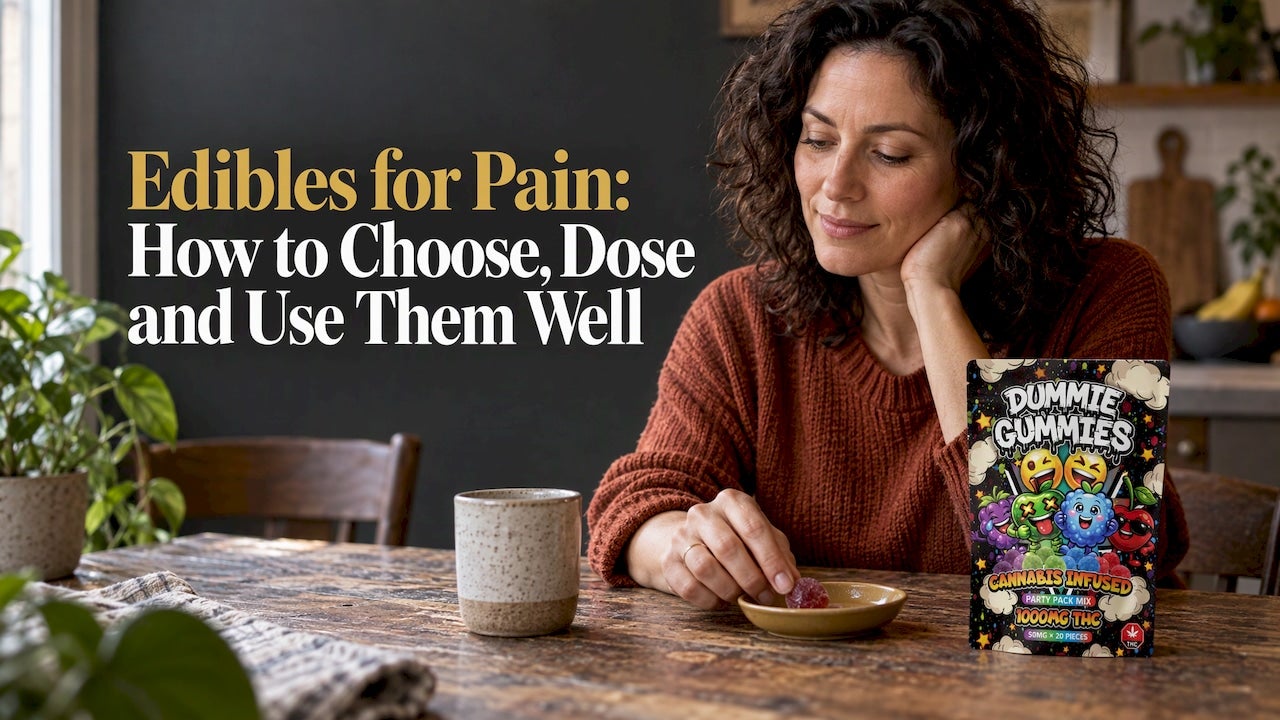
Most people who try edibles for pain want steady, longer-lasting comfort without inhaling anything. Edibles can fit that goal, but they work differently from smoking or vaping. Effects arrive late, last long and depend heavily on dose. Pick a clear THC and CBD ratio, start at a low dose, wait long enough and keep a simple log. That approach gives you the best chance of finding what works for you.
TL;DR
- Health Canada advises starting at 2.5 mg of THC (1.25 mg for some people, including those over 55 or on interacting medications) and going slowly.
- Edibles can take 30 minutes to 2 hours to start and 4 hours to peak. Wait at least 2 hours before taking more.
- Many people with pain begin with CBD-dominant products and add small amounts of THC if needed.
- Research suggests cannabinoids can reduce pain, but the effect varies by person and pain type, and edibles in particular have been studied less.
- Talk to your doctor or pharmacist first if you take other medications. Store edibles locked and away from children and pets.
Table of Contents
- What the research says about edibles and pain
- Why people choose edibles for pain
- THC, CBD or both: choosing a ratio
- Which edible format suits you
- How to dose edibles for pain, step by step
- Timing: how long edibles take and how long they last
- Edibles for nausea
- What to check on the label
- Medications, age and who should check first
- If an edible feels like too much
- Storing edibles safely
- Our perspective
- Shop edibles with the details in front of you
- FAQ
- Sources
What the research says about edibles and pain
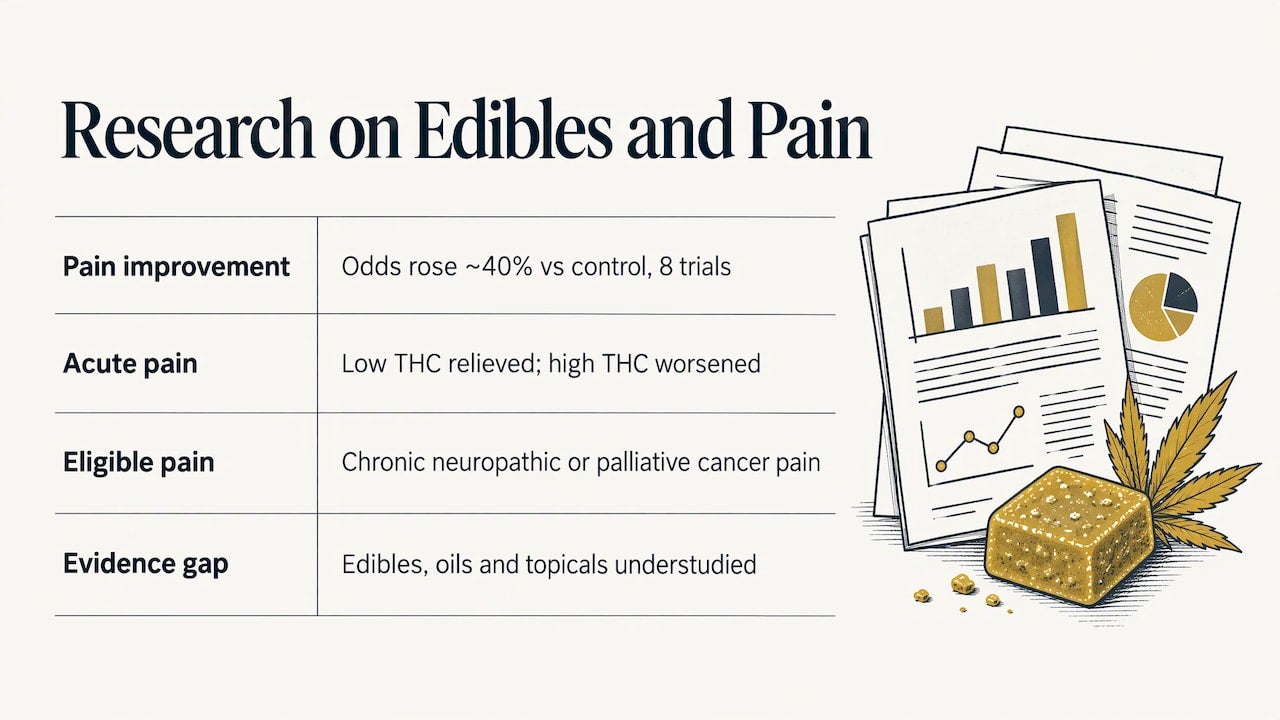
The honest picture is encouraging but uneven. The Canadian Centre on Substance Use and Addiction summarizes the evidence this way: cannabinoids can reduce pain, though the size of the effect differs across studies and pain types. A major review from the U.S. National Academies found that plant-derived cannabinoids raised the odds of pain improvement by roughly 40 percent compared with a control, across eight trials.
That is useful context for choosing a product, because pain is personal. Nerve pain, arthritis pain, muscle tension and post-injury pain do not respond in the same way, and a dose that helps one person may do little for another.
The College of Family Physicians of Canada suggests that cannabis may be considered for chronic neuropathic pain or palliative cancer pain that has not responded to standard treatment. The same guidance notes that research specifically on edibles, oils and topicals is still thin. In practice, that makes careful dosing and good records your best tools. You are running a small personal experiment, ideally with a clinician who knows your history.
Health Canada’s clinician guidance adds one more useful point. In lab studies of acute pain, lower THC doses had a pain-relieving effect while higher doses made pain worse. More is not better. A low, steady dose is often the smarter path.
Why people choose edibles for pain
Edibles have a few practical advantages, and a JAMA Internal Medicine review names several:
- Measured servings. A gummy or chocolate square has a set amount of THC and CBD, so dosing is more reliable than with a joint.
- No lung exposure. Edibles spare the lungs from the injury linked to smoking and vaping.
- Long duration. Effects run longer than inhaled cannabis, which suits pain that lingers through an afternoon or evening.
The flip side of long duration is slow onset. That is the single most important thing to plan around.
THC, CBD or both: choosing a ratio
The two main cannabinoids behave differently. THC is the one that causes a high. CBD does not, and it may soften some of THC’s unwanted effects. If you want the full comparison, our guide on the difference between THC and CBD covers it, and our piece on CBD and pain relief goes deeper on that side.
The Arthritis Society Canada suggests people with arthritis start with CBD-dominant products and introduce THC in small amounts if needed. It also notes that CBD can help counteract some negative effects of THC when the two are used together, while small doses of THC can help reduce pain, anxiety, tension and nausea.
A simple way to think about it:
| Goal | Ratio to look for | Why |
|---|---|---|
| Daytime comfort, staying clear-headed | CBD-dominant, little or no THC | No intoxication, easy to repeat |
| Pain that returns in the evening | Balanced THC and CBD | CBD may take the edge off THC |
| Pain that interrupts sleep | Low THC plus CBD, taken well before bed | Long duration covers the night |
| Experienced user, higher tolerance | THC-dominant | Only after you know your response |
On the sativa versus indica question that dominates many product pages: the label and the cannabinoid numbers tell you far more than the strain name. Judge by milligrams of THC and CBD, then by how you feel.
Which edible format suits you
Format changes how much you can control your dose.
| Format | Dose control | Notes |
|---|---|---|
| Gummies | High, one piece at a time | Easy to split, simple to log |
| Chocolate bars | Medium to high | Snap off a marked square |
| Lollipops and hard candy | Medium | Slower, more gradual use |
| Tinctures | High, measured by dropper | Held under the tongue, timing differs from swallowed edibles |
| Beverages | Medium | Check the dose per serving |
For a first run, a gummy or a scored chocolate is easiest because you can take exactly one small piece. Browse our edibles collection and read each product page for the milligrams per piece before you choose.
How to dose edibles for pain, step by step
Health Canada’s guidance on using a cannabis product is clear: start with the lowest dose, go slowly, and work with a health care provider on products and dosage. For edible, drinkable or sublingual THC, it recommends starting at 2.5 mg once daily, or 1.25 mg for some people, including those over 55 or taking medications that may interact.
- Check the label. Find the THC and CBD milligrams per piece, not just the package total. A large package holds many doses.
- Take 2.5 mg of THC or less. If you are over 55 or on other medications, 1.25 mg is the figure Health Canada gives. The Nova Scotia government also describes 2.5 mg or less as a low dose for edibles.
- Wait at least 2 hours. Do not take more because you feel nothing at 45 minutes. Nova Scotia advises waiting at least 2 hours before another dose.
- Stay at that dose for a few days. Note your pain level, sleep, mood and side effects.
- Raise it a little at a time. Increase in small steps only when the previous dose has settled.
- Stop at the lowest dose that helps. The goal is comfort, not intensity.
A simple log helps. Write the time, product, THC and CBD amounts, food eaten, pain score before, and pain score after four hours. After a week you will see a pattern.
If you want to go even gentler, micro-dosing fits well with pain management, since the aim is a subtle effect rather than a high.
Timing: how long edibles take and how long they last
Health Canada says edible effects can start within 30 minutes to 2 hours, be strongest after 2 to 4 hours, and last 4 to 8 hours, depending on the product, food in your stomach and oral medications. Its consumer guidance and the Nova Scotia government both add that effects can last up to 12 hours, with some residual effects up to 24 hours.
The reason is how the body processes them. When you eat or drink cannabis, THC passes through the stomach and liver and becomes a more potent compound, 11-hydroxy-THC, before it reaches the bloodstream.
Plan around that:
- Take your first doses on a day with nothing demanding, with someone nearby if possible.
- Do not drive or operate machinery while you are feeling effects.
- For night pain, take the edible in the early evening, not at the moment the pain wakes you.
Edibles for nausea
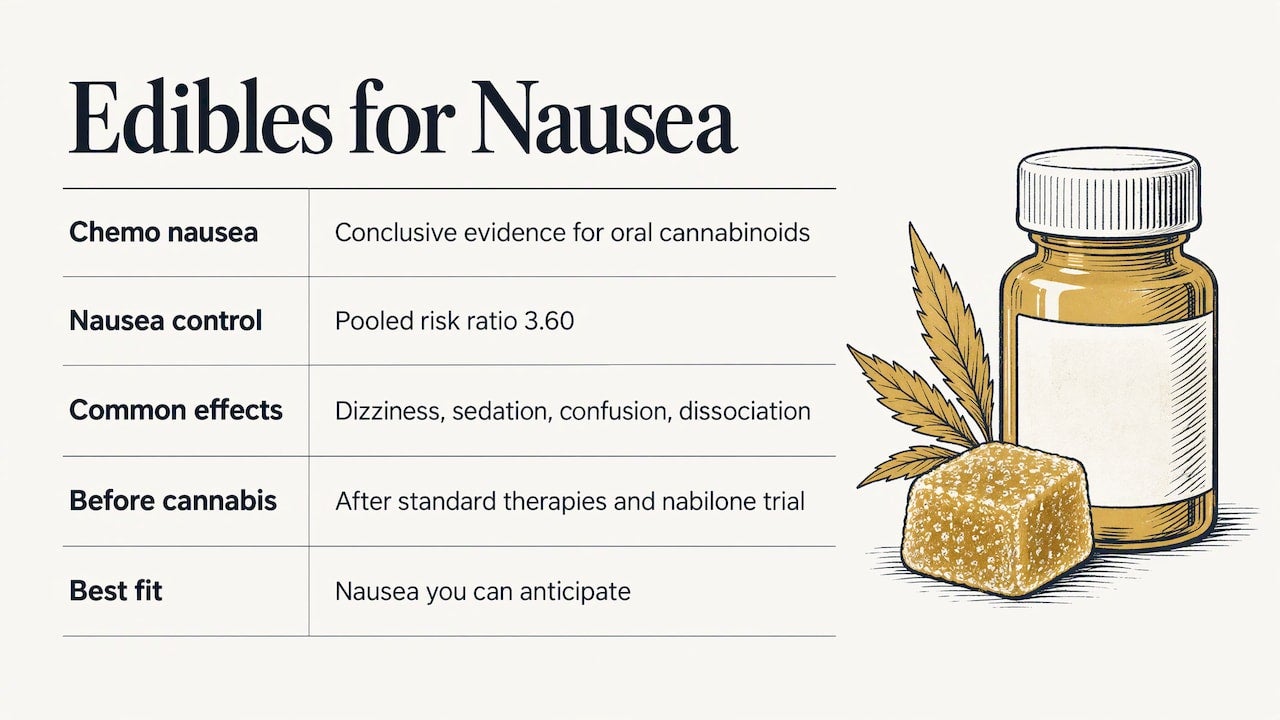
Nausea is the other common reason people reach for edibles. The best-established evidence involves nausea from chemotherapy. The CCSA reports that the 2017 National Academies review found conclusive evidence for oral cannabinoids against chemotherapy-induced nausea and vomiting. A Canadian review of reviews found a pooled risk ratio of 3.60 for controlling that kind of nausea, meaning patients were substantially more likely to see benefit than with a comparison.
The same review lists dizziness, sedation, confusion and dissociation as common effects, which is another reason to keep doses low. The CFPC suggests considering cannabis for chemotherapy-related nausea after standard therapies and a trial of nabilone, a prescription cannabinoid. If you are in treatment, speak with your oncology team before using any edible. Our article on cannabis in cancer treatment gives more background.
The JAMA review also notes that unrelenting nausea and vomiting are less common with edibles than with smoked cannabis. For everyday queasiness, the same low-dose, slow approach applies. Keep in mind that an edible takes time to work, so it suits nausea you can anticipate better than nausea that is already severe.
What to check on the label
Canadian labels are standardized, which makes comparing products straightforward. Health Canada’s label guide says the front must show total THC and CBD, and edible labels must list food allergens, gluten and added sulphites, and include a nutrition facts table.
Before you buy, check:
- THC and CBD per piece, and pieces per package
- Allergens and ingredients, especially if you have food sensitivities
- The ratio, matched to the goal in the table above
- Storage and serving instructions
Regulations also cap legal edible products at 10 mg of THC per unit or serving, with standard dosing information in milligrams, which is why a per-piece figure is the number to read.
Medications, age and who should check first
Edibles are not a good fit to start on your own if you take other medications. Health Canada specifically lowers the suggested starting dose for people over 55 or on potentially interacting drugs. If you take blood thinners, sedatives, opioids or anything else with a warning about drowsiness, ask your pharmacist or doctor before your first dose. Our article on cannabis for seniors covers extra considerations for older adults.
The side effects to know about: dizziness, sedation, confusion and a racing heart. Nova Scotia notes that taking too much can cause extreme sedation, anxiety, paranoia, hallucinations, rapid heartbeat and respiratory depression. The Canadian review of reviews also points out that adverse events are probably underreported, especially for people new to cannabinoids. Starting low is how you stay in the comfortable range.
The College of Family Physicians also cites a Colorado study in which edibles accounted for about 11 percent of cannabis-related emergency visits despite being only 0.3 percent of sales, with more intoxication and acute psychiatric symptoms than inhaled cannabis. The takeaway is practical: delayed onset leads people to take a second dose too early.
If an edible feels like too much
If you have taken too much, the effects are usually temporary, but they can be frightening. A few steps help while it passes:
- Stay calm and remind yourself that the feeling will fade.
- Sit or lie down somewhere quiet and safe, with water nearby.
- Ask someone you trust to stay with you.
- Do not take more, and do not drive.
Call 911 or your local poison centre if you have chest pain, trouble breathing, fainting, confusion that worsens, or if a child or pet has eaten an edible. Health Canada lists signs of accidental ingestion in children that include rapid heartbeat, vomiting, drowsiness, unsteadiness, slurred speech and loss of consciousness.
Storing edibles safely
Edibles look like ordinary treats, which makes storage a safety point. Health Canada advises keeping cannabis out of the reach and sight of children, teens and pets, ideally in a locked drawer or box, separate from regular food and drinks. It also says to buy only legal products from authorized sources. Keep the original packaging so the dose information stays with the product.
Our perspective
Most of the questions we get about pain come down to one worry: will this work, and will it be too much? We think the answer is to make the first step small and the information plentiful.
That is why we build our product pages around detail, with the product type, the milligrams, reviews from other customers and live chat for questions you want answered before you order. Our help center is there for the basics too, from how long edibles take to what the label means.
We carry gummies, chocolate, lollipops, tinctures, beverages and CBD products so you can choose the format and the ratio that suit your routine, whether you want a CBD-focused option or a gentle introduction to THC. Our approach is to help you pick one product, take a low dose, keep notes and adjust slowly.
Pain is personal, and the best edible is the one that gives you comfort at the lowest dose that works for you.
the author
Shop edibles with the details in front of you
If you are ready to try one, start with the edibles collection and filter by what you want: gummies for precise dosing, chocolate for a scored bar or lollipops for a slower pace. You can also look at our Dummie gummies (1000mg) or the Apollo chocolate bar (1200mg). Read the milligrams per piece on each page and plan your starting dose from that, not from the package total.

For CBD-focused options, see our CBD and topicals range. We ship across Canada, and our live chat team can help you compare products.
FAQ
How long do edibles take to work for pain?
Health Canada says edible effects can begin within 30 minutes to 2 hours and are strongest after 2 to 4 hours. They can last 4 to 8 hours, and sometimes longer. Wait at least 2 hours before deciding whether to take more.
What is a safe starting dose for pain?
Health Canada recommends 2.5 mg of THC once daily for edibles, or 1.25 mg for some people, such as those over 55 or on interacting medications. Increase slowly and only when needed. Your doctor or pharmacist can help set a plan around your other medications.
Are CBD edibles or THC edibles better for pain?
Neither is better for everyone. The Arthritis Society Canada suggests starting with CBD-dominant products and adding small amounts of THC if needed. Balanced products can give you the benefits of both with a gentler feel.
Can edibles help with nausea too?
The strongest evidence concerns nausea from chemotherapy, and doctors usually consider cannabinoids after standard treatments. Dizziness and sedation are common, so low doses matter. Speak with your care team if you are in treatment.
Sources
- CCSA: Clearing the Smoke on Cannabis, Medical Use of Cannabis and Cannabinoids (2024)
- National Academies: The Health Effects of Cannabis and Cannabinoids
- CFPC: Guidance in Authorizing Cannabis Products Within Primary Care
- Health Canada: Information for health care professionals on cannabis and cannabinoids
- JAMA Internal Medicine: I Am Curious About Cannabis Edibles
- Arthritis Society Canada: Medical Cannabis, CBD and THC
- Health Canada: Using a cannabis product
- Government of Nova Scotia: Extracts and Topicals
- Health Canada: What you need to know if you choose to consume cannabis
- Allan et al.: Systematic review of systematic reviews for medical cannabinoids
- Health Canada: How to read a cannabis product label
- Health considerations of the legalization of cannabis edibles
- Health Canada: Accidental ingestion of illegal copycat edible cannabis products
Recommended
- Healing Naturally: The Science Behind CBD Pain Relief
- A Silver Lining: Cannabis Consumption for Seniors
- The Ultimate Elixir: Incorporating Cannabis Oil into Your Daily Routine
- Discover the Best Cannabis Strains for a Restful Night’s Sleep
